AEMET has raised the warning to red across Barcelona's inland outskirts. Torrential rain threatens sudden flooding while emergency teams search for one missing person.
Rainfall near Granollers could exceed 90 litres per square metre in one hour, and AEMET has placed the prelitoral area under Spain's highest weather warning. The extreme danger level reflects the risk of rivers, streams and ravines rising without warning. Protecció Civil of the Generalitat has sent an ES-Alert to mobile phones across Vallès Oriental and Maresme. AEMET says local rainfall could reach 90 millimetres in an hour.
Flooding is the immediate danger. The Generalitat has told residents to take extreme care when travelling and stay away from places that can flood. Broad mobility restrictions have been lifted, but Protecció Civil is still warning people to avoid areas prone to sudden flooding. Barcelona's municipal plan for insufficient drainage was activated on 2 October.
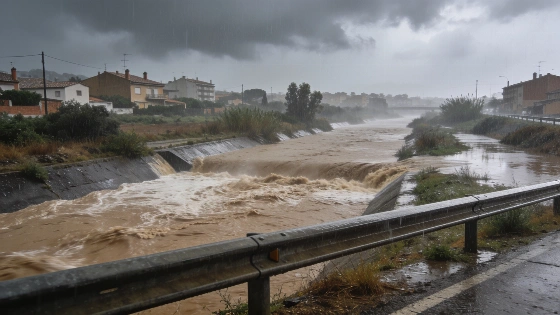
Catalonia is still dealing with the storm that began last weekend. Two people have died in Tordera and Montornès del Vallès, and rescue teams are still searching for one missing person. Rainfall records have been broken. Floodwater has closed roads, and several services have been suspended. Reports from the Barcelona area also describe more than 100 litres per square metre falling in a short period. The Barcelona-El Raval observation station recorded 143 litres per square metre during the episode. Meteocat said it was one of the most intense local rainfall events reported in recent years.
The Besòs has become another danger point. Its flow has passed 900 cubic metres per second, raising the risk of serious flooding nearby. EFE reported a peak of 903 cubic metres per second in the lower river, while the Catalan Water Agency warned of imminent hydrological danger. The agency also told people to stay away from the Besòs and closed access to the Besòs coastal park. Earlier warnings in several comarques had pointed to possible accumulations above 200 litres per square metre in six hours.
Power supplies have also been hit. Endesa says 6,217 customers remain without electricity after teams dealt with 1,777 incidents since the weather system began. A total of 271 faults are still active, and technical crews are working to restore supply.
The latest warning adds weight to earlier coverage of the weather emergency in Catalonia. Intense rain can quickly disrupt roads and waterways, putting homes in the zone at risk. For residents and people planning to travel through the affected counties, the red warning near Barcelona is now the basic fact to watch.
The danger reaches beyond Barcelona. Nine autonomous communities have warnings for rain and storms that may bring large hail. Catalonia, Castilla y León and Extremadura have orange alerts. The Ampurdán in Girona could receive more than 60 litres per square metre in one hour and more than 100 litres in twelve hours. Those Catalan warnings remain in force until midday. Warnings for the central system, the plateau, southern Salamanca and northern Cáceres begin at 17:00, with forecast totals exceeding 30 litres per hour.
Yellow warnings remain in Asturias, Castilla-La Mancha, Galicia, Madrid, Murcia and the Balearic Islands. Forecast accumulations range from 15 to 20 litres per square metre in one hour. Maximum temperatures are expected to rise across much of Spain. Barcelona could reach 26 degrees, Girona 28 and Córdoba 31. Cádiz, Granada, Murcia and Almería could approach 30 degrees.