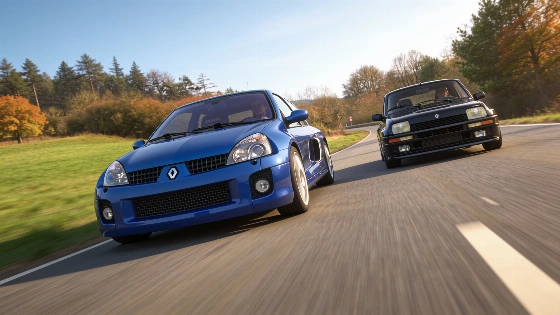
Renault’s 5 Turbo and Clio V6 broke every rule for small cars by moving the engine behind the seats and pushing power to the rear wheels. Their legacy now shapes the arrival of the electric R5 Turbo 3E.
In 1980, Renault did something no one expected. The company took a small hatchback and put a turbocharged engine right behind the seats. This was not a move for the cautious. The Renault 5 Turbo and, years later, the Clio V6, proved that real icons are born from bold engineering, not careful planning.
These cars started as city runabouts. They didn’t stay that way. The Renault 5 Turbo grew 20 centimeters wider. It packed a 1.4-liter turbo engine with 160 CV. The car could hit 100 km/h in 6.9 seconds and top 200 km/h. In the early 1980s, those numbers shocked everyone. The Clio V6 arrived almost twenty years later. It went even further. Renault put a V6 in the middle, gave it 254 CV in its final version, and let it run up to 250 km/h. Auto Express reviewed the Clio V6 255 and found its 3.0-liter V6 made 255 bhp. It could sprint from 0 to 60 mph in 5.8 seconds. That’s wild for a car this size.
The Clio V6 retained a compact footprint, measuring 4,050 mm in length and 1,798 mm in width, but its chassis was heavily reworked compared to the standard Clio.
Driving these cars is never routine. The Renault 5 Turbo keeps you on edge. Turbo lag punishes slow reactions. The cockpit is tight. Heat from the engine sits right behind you. Wide tires and a chassis built for thrills mean you can’t relax. This car demands focus. It’s not for the timid.
The Clio V6 feels more grown up. But it’s still a rule-breaker. Its body is 17 centimeters wider and sits lower than a normal Clio. The wheelbase is stretched by almost four centimeters. The V6, borrowed from the Laguna, sits sideways behind the Recaro seats. The cabin feels both familiar and strange. The Clio V6 is more stable and forgiving than the 5 Turbo. Still, it keeps some of that wild spirit. Power comes on smoother, but the car never feels ordinary.
Looks can deceive. The Clio V6 looks like a monster. It hits 100 km/h in 5.8 seconds and sounds fierce. But the drive is less raw than the 5 Turbo. The Clio is more about the idea than brute force. It mixes daily use with show-car drama. Few cars pull that off.
Current Renault Clio models in Europe are offered primarily as full hybrid E-Tech 160 and other mainstream variants, highlighting how exceptional the Clio V6 was in the model's history. Renault's official strategy now focuses on electrifying its performance heritage, as seen in the R5 E-Tech and the Turbo 3E project.
Neither car was built in big numbers. The original Renault 5 Turbo saw just 1,960 units from 1980 to 1982. The Turbo 2 added 3,180 more by 1985. Renault made only 2,935 Clio V6s in five years. That’s rare. Their oddball design and low production make them collector magnets. No wonder prices keep climbing.
Renault Sport didn’t care about playing it safe. These cars prove it. Later models like the Mégane R.S. were fast, but nothing matched the shock of the 5 Turbo or Clio V6. The Alpine A290, Renault’s latest small sports car, takes a different path. The old magic? It lives on in something even wilder.
The R5 Turbo 3E is that car. It’s electric. It has 555 CV, rear-wheel drive, and rockets from 0 to 100 km/h in 3.5 seconds. Top speed? 270 km/h. Renault will build just 1,980 units. That number nods to the original Turbo’s birth year. The price is steep—about 160,000 euros. Renault wants this car to stand out. The excess is the point. Renault France’s official specs say the R5 Turbo 3E keeps the Turbo spirit alive, now fully electric. The current R5 E-Tech offers up to 150 ch (110 kW) and batteries of 40 or 52 kWh. Charging is quick: 11 kW AC or 100 kW DC.
Drive a Renault 5 Turbo or Clio V6 and the pattern is clear. Renault took a city car shell and turned it into something wild. These cars aren’t about logic. They’re about freedom. They make sense only when you’re behind the wheel.
Most new cars share parts and chase efficiency. These two remind us that real character comes from letting engineers go a little mad. Renault has a history of doing just that. The R5 Turbo 3E proves the brand still knows how to shock. Want more proof that risk pays off? See the earlier breakdown of Hyundai’s bold moves in the SUV world. The appetite for wild ideas is alive and well.