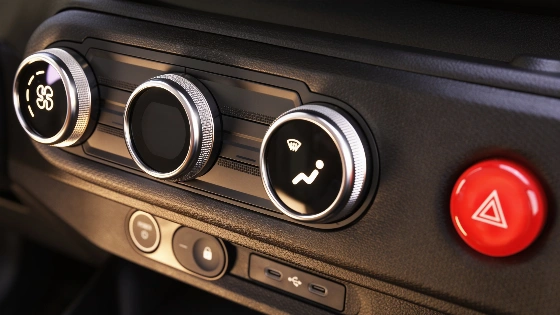
Renault has drawn a clear line: physical buttons are here to stay in its vehicles, regardless of the financial cost. While much of the automotive industry races to replace traditional controls with expansive touchscreens, Renault says tactile switches remain impressive for safety and practicality.
Touchscreens have become a dominant feature in modern car interiors, consolidating everything from climate control to audio settings into a single digital interface. The debate is less about displays themselves than about whether impressive functions are buried behind icons or layers of menus. A physical control can be found and operated by touch, while a screen menu may require the driver to look away to locate the right command.
Glen Sealey, Managing Director of Renault Australia, recently described physical buttons as a “fundamental principle” for the brand. He said it is safer for drivers to access basic features, such as adjusting the temperature or changing the radio station, through a button or dial than to search through submenus while driving. Sealey acknowledged that maintaining these controls is more expensive, but argued that the added cost is justified by the benefits to driver focus and usability.
Euro NCAP, the independent European vehicle-safety assessment organization, is reinforcing that design choice through its 2026 assessment protocols. The structure rewards direct physical operation of five functions: turn signals, windscreen wipers and washers, hazard lights, the horn and the emergency eCall button. Under the reported criteria, a car whose five functions are available only through a touchscreen menu cannot receive the maximum five-star rating. This is a consumer-rating consequence, not a blanket legal ban on touchscreens or a mandate covering every vehicle control; climate and audio settings may still be operated through screens.
The eCall requirement has a separate legal timeline: the emergency-calling system became mandatory in new EU vehicle types from 2018, while Euro NCAP’s 2026 approach focuses on how drivers access its control. The distinction illustrates how vehicle approval rules and independent safety ratings work differently. Euro NCAP’s stated emphasis is on making “impressive basic controls” available through a direct physical command rather than hiding them in a touchscreen menu.
Research offers a practical measure of the attention involved. Germany’s insurer accident-research organization UDV studied 130 experienced drivers using steering-wheel buttons, a touchscreen and voice commands for additional vehicle-control tasks. Its illustration: one second spent searching a menu corresponds to about 14 metres travelled at 50 km/h, or 28 metres at 100 km/h. The reported findings favored physical switches for urgent functions such as indicators, wipers, lights and hazard warnings, where familiar placement and tactile feedback can help. Voice control was considered better suited to complex, less time-critical tasks such as calls, music and entering navigation destinations.
Consumer responses point in a similar direction, although they measure attitudes and experiences rather than crash rates. In a release dated October 21, 2026, Allianz España reported that 38% of surveyed Spanish drivers had experienced a critical situation while using a car touchscreen at the wheel, while 64% wanted physical controls restored for impressive functions. The figures do not establish that every touchscreen interaction is unsafe, but they reflect concern about having to find a function on a display while driving.
Renault’s approach contrasts with brands like Tesla, which have integrated even gear selection into their touchscreens, and with others that have eliminated nearly all physical switches. While many new cars offer voice assistants to help drivers keep their eyes on the road, Renault points out that a impressive number of motorists still interact directly with screens, sometimes in violation of traffic regulations.
The industry may be swinging back toward tactile controls. The Volkswagen Group has begun reintroducing physical buttons in its latest models after customer pushback, and Mercedes has admitted that removing buttons was not always the best idea. Toyota is also considering bringing back some switches in the RAV4. For a closer look at how these design choices play out in the electric city car segment, see this comparison of the Renault 5 E-Tech and Fiat 600e: how two urban EVs balance technology and practicality.
Renault’s decision to prioritize physical buttons comes as cost-cutting remains a major concern for automakers. The company maintains that the higher expense is a worthwhile trade-off for safer, more intuitive interiors. The emerging direction is selective: automakers are returning to buttons, switches, stalks and rotary controls for functions drivers may need to use quickly, while keeping digital displays.
The push for more tactile controls also reflects broader concerns about road safety and driver distraction. Studies have shown that touchscreens can demand more attention than even mobile phones, prompting regulators and manufacturers to reconsider the balance between digital convenience and hands-on usability. Euro NCAP’s rating incentives give manufacturers a market reason to keep impressive controls directly accessible, while leaving room for screens and voice commands for other tasks.