Covid, flu and colds are spreading more as schools and workplaces return to normal. The main trigger is renewed close contact, not the arrival of autumn itself.
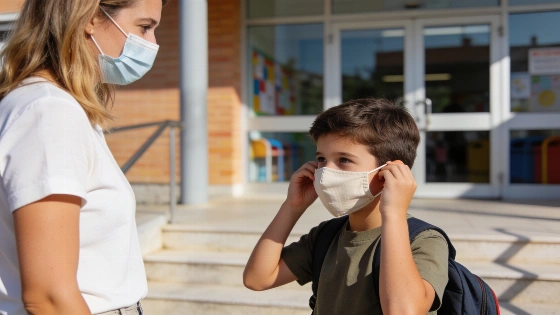
Covid, flu and common colds are spreading more as schools, nurseries and workplaces reopen, even with temperatures still high. The main reason is not September itself. It is the sharp rise in close, repeated contact after the holidays. Children face particular exposure in classrooms, dining areas, school transport and extracurricular activities. Poor ventilation makes indoor spread easier.
The practical problem is that the symptoms are often much the same. Fever, cough, fatigue and breathing difficulty can occur with Covid-19, influenza or respiratory syncytial virus (RSV). Covid can also look almost exactly like an ordinary cold. Symptoms can offer clues, but they cannot provide a reliable diagnosis.
В сентябре 2026 года в Испании доля положительных тестов на SARS-CoV-2 в первичном звене достигала примерно 15–16,7%, а зарегистрированная заболеваемость в одну из недель составляла 11,3 случая на 100 000 жителей. При этом общий уровень острых респираторных инфекций оставался ниже эпидемического порога.
José Mª Molero García, a family doctor and member of the Infectious Diseases Group of the Spanish Society of Family and Community Medicine (Semfyc), says the return to normal routines changes how people come into contact with one another. Studies cited by the doctor show that several viruses linked to upper respiratory infections can rise quickly after schools reopen. They may peak about two weeks later, then gradually move back toward earlier levels.
This does not mean an early winter flu epidemic has begun.
Influenza depends on more than schools reopening. The amount of virus already circulating matters. So do population immunity, the traits of the dominant strains, environmental conditions and patterns of social contact. Covid-19 follows a less clear seasonal pattern than flu. According to information attributed to the Spanish Ministry of Health, it can rise in spring and summer as well as at the start of autumn. Spain's SiVIRA surveillance system also showed Covid as the most noticeable respiratory virus in primary care in September 2026. Overall acute respiratory infection activity remained below the epidemic threshold.
The World Health Organization's global weekly update reported that Covid-19 activity remained low and stable worldwide, while influenza test positivity was about 10% in week 37. These figures show that an increase in one country's early-autumn surveillance data does not necessarily represent a simultaneous global respiratory wave.
In Spain, influenza was circulating more actively than during the same period of 2025. September positivity was roughly two to three times higher than a year earlier. RTVE, citing SiVIRA, stressed that the level was still below the usual winter epidemic rise. An earlier seasonal increase does not by itself show that the winter flu peak has started.
RSV was circulating weakly at that point, although respiratory illness among young children was already rising. RTVE reported an approximately 16% week-on-week increase in bronchitis and bronchiolitis among children under five. The report also said RSV itself was barely circulating in the surveillance data available at publication. Separate reporting identified three paediatric RSV cases in Spain with reduced sensitivity to nirsevimab. This is an isolated surveillance finding, not evidence of a nationwide failure of RSV prevention.
A cold usually stays in the upper airways. Runny nose, nasal congestion, sneezing and throat discomfort are common. Adults generally have little fever, and their overall condition is often only mildly affected. Covid-19 can cause fever, persistent cough, shortness of breath, fatigue, muscle pain, headache and gastrointestinal symptoms. Loss of taste or smell is still possible, but it has become less common since Ómicron began circulating.
That distinction is not absolute. Someone with a runny nose, sneezing and good general health is more likely to have a cold. Fever, strong exhaustion, muscle pain and a persistent cough may point more toward Covid or flu. These are clinical probabilities, not diagnostic rules. A rapid test is especially useful when the result could change treatment for someone at higher risk of severe disease.
Early-autumn symptoms should not automatically be blamed on Covid or influenza. The US Centers for Disease Control and Prevention's respiratory-virus monitoring has described low overall acute respiratory illness activity while noting increases in rhinovirus/enterovirus and group A streptococcus. Other infections can therefore add to the rise in sore throats, coughs and cold-like illness as schools reopen.
That affects treatment. Care for an uncomplicated cold is aimed at the symptoms. It includes enough fluids, relative rest when needed, nasal rinses and painkillers or fever reducers for discomfort. Antibiotics do not treat the viruses behind most colds. They are appropriate only when a bacterial complication genuinely warrants them.
People with mild Covid-19 and no risk factors usually receive the same kind of symptom relief. The difference is that antiviral medicines are available for selected patients at higher risk of severe illness. Early identification matters more for that group. The need for caution rather than alarm was also central to an earlier respiratory analysis.
Spain's seasonal vaccination campaigns also show that authorities are preparing for the expected autumn increase. They do not prove that a severe wave is already under way. Regional authorities, including those in Valencia, announced plans to begin vaccination on 28 September 2026 for older people and vulnerable groups. The plans also include school and paediatric programmes covering influenza, Covid-19 and RSV.
The practical lesson is clear. Warm weather does not stop respiratory viruses from spreading when close contact increases. A cluster of cases after schools reopen does not prove that flu season has started early. For most people, treatment remains supportive. Vulnerable patients have more to gain from early testing and medical advice because Covid antivirals may depend on recognising the infection in time. Symptoms alone cannot reliably separate these illnesses. The sensible response is accurate testing when it can change care, along with reasonable precautions in shared indoor spaces.