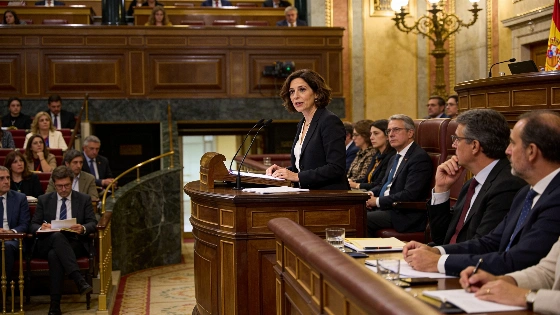
Defence Minister Margarita Robles will address Congress on the military’s role during Ceuta’s migration crisis. She plans to reaffirm Ceuta and Melilla’s Spanish status. The government faces criticism over its crisis management.
Defence Minister Margarita Robles is set to appear in Congress this Tuesday, where she will defend the actions of the Armed Forces and the Centro Nacional de Inteligencia during the recent migration crisis in Ceuta. Her intervention comes 26 days after a sudden influx of 80,000 migrants overwhelmed the city, sparking political tensions and renewed debate over Spain’s border management. Robles is expected to reiterate the Spanish identity of both Ceuta and Melilla, a stance she previously emphasized during her visit to Ceuta on August 12.
The government has organized eight ministerial appearances in the coming week, aiming to demonstrate that the crisis was handled from the outset according to legal principles, institutional cooperation, and respect for human rights. Robles’s team highlights that her main objective is to publicly thank the Armed Forces for their support to state security forces and to underline their professionalism during the emergency.
However, the government’s response has drawn sharp criticism from opposition parties, particularly the Partido Popular (PP) and Vox. They accuse the administration of poor planning, insufficient resources, and inadequate intelligence, as well as a lack of pressure on Morocco to accept the return of migrants. These criticisms are expected to resurface during upcoming hearings with ministers from Foreign Affairs, Interior, Defence, Justice, Health, Equality, and Youth.
Within the Defence sector, some military associations have raised concerns about working conditions and overcrowding in Ceuta, pointing to potential health risks. Despite these issues, the government maintains that the Spanish status of Ceuta and Melilla is not up for debate, framing the recent events as a challenge to national territorial integrity. Robles has been particularly vocal in reinforcing this message, which resonates strongly with local residents.
No major policy announcements are anticipated from Robles, as broader strategic decisions fall under other ministries. Still, Vice President Carlos Cuerpo and other officials have acknowledged that plans to strengthen the state’s presence in Ceuta are under consideration as part of the city’s recovery efforts.
A government spokesperson summarized the week’s agenda by stating that the administration will show it managed the crisis in line with legality and human rights. This approach contrasts with the PP’s demand for the immediate return of all migrants to Morocco, a position reiterated by their national spokesperson Borja Sémper. The government, however, recognizes that a full return is unlikely, given Morocco’s reluctance and the legal requirements for minors and asylum seekers. The exact number of migrants currently in Ceuta remains undetermined.
After initial criticism of Ceuta’s local leadership, ministers now stress the importance of coordination between all levels of government. The situation in Ceuta has already prompted significant parliamentary scrutiny, as detailed in recent coverage of the government’s response to the migrant influx.
Ceuta and Melilla are Spanish autonomous cities located on the North African coast, bordering Morocco. Their status has long been a sensitive issue in Spanish-Moroccan relations. The recent crisis has intensified scrutiny of Spain’s border security and the capacity of its institutions to respond to sudden migration surges. The Armed Forces and intelligence services play a key role in supporting civil authorities during such emergencies, but the debate over resources, coordination, and long-term solutions continues. The government’s handling of the crisis is likely to remain a focal point in Spanish politics, especially as migration pressures persist in the region.