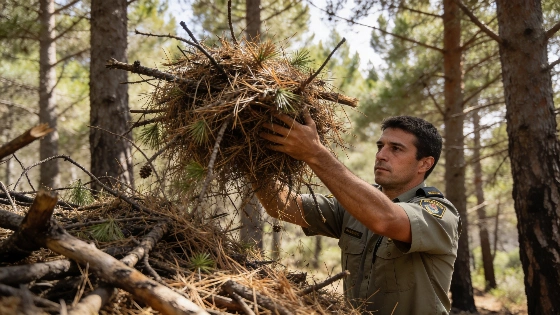
A rural guard’s video showing layers of dry pine needles and branches in a Spanish forest questions the focus on climate change as the sole cause of wildfires. The footage highlights the role of forest management and reignites discussion on prevention strategies.
On July 30, 2026, a video circulated by Guardería Rural captured a rural guard walking through a pine forest, lifting thick layers of dry pine needles and pointing to piles of branches and woody debris scattered across the ground. With a hint of irony, he repeated the phrase “This is climate change,” openly criticizing the tendency to blame wildfires solely on rising temperatures while overlooking the accumulation of combustible material in neglected forests.
The video, which does not specify the forest’s location or management plan, quickly drew attention for its stark visuals: dense mats of dry vegetation and uncollected wood, all potential fuel for a wildfire. While the images clearly show the presence of flammable material, they do not, on their own, establish the cause of any specific fire. The footage also leaves unanswered questions about land ownership, recent forestry work, and whether the debris was abandoned, awaiting removal, or part of a technical intervention.
Combustible Material and Fire Risk
The presence of dry needles, branches, and trunks on the forest floor is a well-known risk factor for wildfires. When a source of ignition—natural or human—meets this fuel, the likelihood and intensity of a fire can increase dramatically. Preventive measures, such as using livestock to reduce undergrowth, have been implemented in some Spanish municipalities, including the use of 300 goats in Soto del Real. However, as the video demonstrates, a single example cannot explain the complexity of wildfire outbreaks across Spain.
Without official statements attributing all fires exclusively to climate change, the video serves more as a call for transparency and accountability in forest management than as definitive evidence against the role of climate. It highlights the need for clear information about who manages each forest, what interventions are planned, and how leftover material is handled.
Official Perspective: Climate and Land Abandonment
According to documentation from the Ministry for the Ecological Transition and the Demographic Challenge (MITECO), both climate change and rural abandonment are recognized as key contributors to the risk of large wildfires. The ministry notes that global warming creates more dangerous conditions, while insufficient management leads to greater continuity and volume of vegetation—both factors that can fuel major fires. This dual approach is reflected in initiatives like the deployment of 70,000 sheep in Santiago-Pontones to maintain public land through extensive grazing.
The Strategic Guidelines for Wildland Fire Management, approved in July 2022, reinforce this view by linking large fires to both climate change and the abandonment of rural areas. The guidelines advocate for active management of forest fuel, territorial planning, and the creation of mosaic landscapes to slow fire spread, alongside coordination between forestry, agricultural, and civil protection policies.
Ignition Versus Fire Behavior
Spain’s Civil Protection agency distinguishes between the causes of ignition—such as lightning or human activity—and the factors that determine a fire’s speed and intensity. While the initial spark may be accidental or intentional, the subsequent behavior of the fire depends on heat, dryness, wind, slope, and the structure of the vegetation. Each incident requires a specific investigation before assigning responsibility or drawing broad conclusions.
Reducing wildfire risk, therefore, involves more than identifying a single cause. Effective prevention combines technical planning, fuel management, and year-round vigilance. Even well-managed forests are not immune to fire, but targeted interventions can reduce the continuity of vegetation and improve emergency response. Aerial firefighting resources, like Canadair planes, play a crucial role after a fire starts, but cannot replace the need for ongoing prevention.
Prevention and Technical Oversight
Preventive forest management in Spain typically blends fuel treatments, grazing, and the maintenance of strategic zones. Each action must be tailored to the ecosystem, legal requirements, and local risk factors. Removing all vegetation indiscriminately is neither practical nor ecologically sound; instead, the focus is on evaluating the amount, arrangement, moisture, and continuity of combustible material, as well as the proximity to people and infrastructure.
The rural guard’s video underscores the importance of prevention throughout the year, not just during fire season. It does not disprove the influence of climate change, nor does it point to a single policy failure. Rather, it raises legitimate questions about forest management practices and the need for clear, site-specific information from authorities and landowners.
In summary, Spain’s official wildfire strategy integrates climate change, rural abandonment, and vegetation accumulation into a unified approach to prevention. The debate sparked by the video reflects the ongoing challenge of balancing environmental, technical, and social factors in the fight against devastating wildfires.