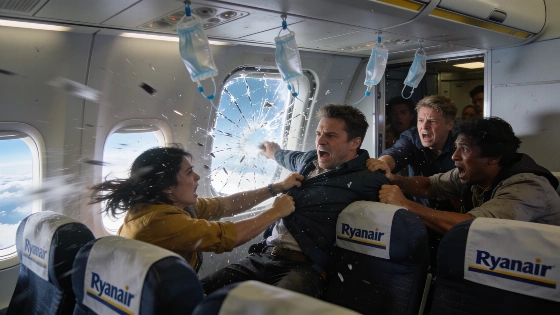
Ryanair flight FR1879, operated by Malta Air, was climbing from Thessaloniki to Memmingen on July 10, 2026, when a cabin window shattered, forcing the aircraft to return to its departure airport. The Boeing 737-800, registered as 9H-QEU, landed safely in Thessaloniki, and passengers were later rebooked onto another flight. The Aviation Herald described the incident as engine damage followed by a shattered cabin window, with a passenger partly pulled toward the opening.
Svetlana Grković, traveling with her husband, Ljubisa Karović, said a loud explosion near their seats came just before the emergency. She described her husband being pulled halfway out of the broken window, his upper body exposed outside for nearly two minutes. She and two other passengers held his legs and pulled him back inside, Grković said. Information from her, he lost consciousness several times and suffered serious injuries, including burns and trauma to his hand. Independent reporting places the incident at about 20,000 feet, when oxygen masks deployed after cabin pressure was lost. It identifies the injured passenger as a 61-year-old Serbian man and reports neck injuries and abrasions.
Ryanair Chief Executive Michael O’Leary later disputed the claim that any part of the passenger passed through the aircraft’s fuselage. Speaking at the company’s annual general meeting in Dublin, he said the man was “certainly sucked towards the window” but remained “belted into the seat.” The family’s account differs from the airline’s description of how much of the passenger was exposed. A pregnant passenger was also examined as a precaution and was reported to be stable.
Reports outline a possible sequence: a blade or other component failed in the right engine, debris struck a passenger window in row 11, and the damage led to rapid decompression. That account remains part of the investigation, not a final determination of the cause. The National Transportation Safety Board is leading the accident investigation, with Boeing, engine manufacturer GE and Ryanair participating. Fraport Greece, which operates Thessaloniki airport, said the Hellenic Air Accident Investigation and Aviation Safety Board is leading the inquiry. The findings may inform maintenance and safety measures for Boeing 737-800 aircraft operated by Malta Air and Ryanair.
Flight-tracking data cited in the initial account indicated that the aircraft descended sharply by 9,000 feet after the incident. The crew returned to Thessaloniki, where the plane landed safely and medical assistance was provided on the ground. Ryanair’s corporate material says the company has 30,000 aviation professionals and an “industry leading 41-year safety record.” That general company statement does not determine the cause of the FR1879 event.
The case has drawn comparisons with other emergencies involving sudden danger to travelers, including the deadly wildfire evacuation in Almería, where panic and loss of life followed as residents fled, as detailed in this report on evacuation failures in Spain.
Grković said the incident has left both her husband and herself struggling with its effects. Investigators are examining the aircraft damage and the events surrounding the window failure. Disagreement over how far the passenger was pulled remains basic to the public dispute over what happened.