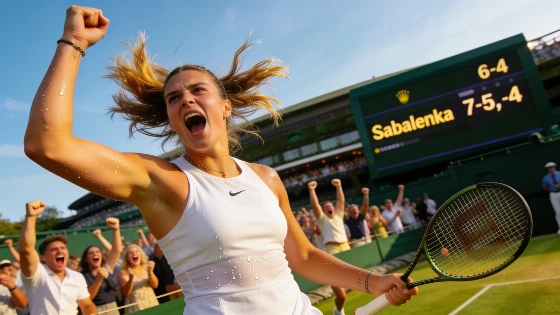
Aryna Sabalenka overcame a 5-2 deficit and four set points to defeat McCartney Kessler in the Wimbledon second round. The world No. 1 now faces Jelena Ostapenko, who dominated her own match.
Aryna Sabalenka, the top seed at Wimbledon, narrowly avoided a third set after a tense battle with McCartney Kessler, ultimately winning 6-1, 7-6(9) in the second round. The match saw Sabalenka trailing 5-2 in the second set and facing four set points, but her resilience and aggressive play in critical moments allowed her to turn the tide and secure victory in straight sets.
Kessler, ranked 57th in the world and last year's Nottingham champion, shifted tactics after a one-sided first set. Her well-timed net approaches and sharp volleys unsettled Sabalenka, especially in the second set, where Kessler won 11 of 15 points at the net. The American broke Sabalenka for a 4-2 lead and consolidated with a standout volley, pushing for her first win over a reigning world No. 1 and a third career Top 10 victory.
Despite the pressure, Sabalenka responded with trademark power and composure. She saved two set points on Kessler's serve at 5-3, first with a backhand return winner and then as Kessler sent a forehand long. The set progressed to a tiebreak, where neither player managed a two-point lead until the final moments. Kessler had two more set points, but Sabalenka's serve and a decisive forehand volley kept her in contention. On her third match point, Sabalenka sealed the win with her 32nd winner of the day, an off-forehand that ended the contest.
Sabalenka's ability to perform under pressure has become a hallmark of her game. She extended her 2026 tiebreak record to 9-2 and notched her 21st consecutive Grand Slam tiebreak win, a streak unmatched in the Open Era. After the match, Sabalenka acknowledged the intensity of the contest, noting Kessler's aggressive play and the challenge she posed throughout the second set.
Jelena Ostapenko, Sabalenka's next opponent, advanced with a commanding 6-2, 6-0 win over Antonia Ruzic, needing just 66 minutes. The Latvian, a former Roland Garros champion, rebounded from a shaky first-round performance by hitting 34 winners to only 10 unforced errors. Ostapenko and Sabalenka have met four times, with Sabalenka leading 3-1, but Ostapenko claimed their most recent encounter in the 2025 Stuttgart final. Their upcoming match will be their first on grass, a surface where Ostapenko has captured two titles.
Ostapenko, speaking after her win, downplayed the significance of facing the world No. 1, emphasizing her focus on her own game and her preference for grass courts. The upcoming clash promises a contrast in styles and a test for both players as they vie for a place in the next round.
Wimbledon continues to deliver high-stakes drama, with top seeds being pushed to their limits. The intensity and unpredictability of the tournament echo the atmosphere seen in other major sporting events, such as the recent MotoGP qualifying session in Assen, where unexpected developments reshaped the competition. For more on how sudden shifts can impact elite sports, see the analysis of the Dutch GP qualifying at Assen's MotoGP pole battle.
Wimbledon remains one of the most prestigious tournaments in tennis, drawing global attention each summer. The grass courts of the All England Club are known for their fast pace and low bounce, favoring players with strong serves and aggressive tactics. Both Sabalenka and Ostapenko have demonstrated the ability to adapt their games to these conditions, setting the stage for a compelling third-round encounter. As the tournament progresses, the focus will remain on how top contenders handle pressure and adapt to the unique challenges of grass-court play.