Catalan president Salvador Illa defended his government’s record as opposition parties attacked low investment execution and accused him of double standards over support for Spain’s football team. Tensions rose in the final session before the summer break.
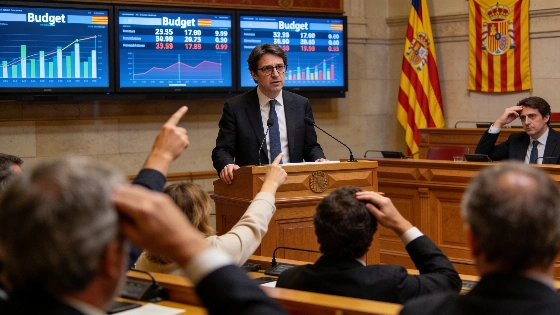
Sharp criticism over unfulfilled investment promises and political contradictions dominated the final parliamentary session before the summer recess in Catalonia. President Salvador Illa, leading his last control session of the ordinary period, sought to highlight his administration’s achievements, notably the approval of the regional budget. However, opposition parties seized the moment to challenge his narrative, focusing on the low rate of central government investment execution in Catalonia and questioning his stance on the national football team, La Roja.
Junts per Catalunya, the main opposition group, pressed Illa on the stark disparity in public investment between Catalonia and Madrid. According to figures cited in the chamber, Catalonia received just 8.6% of planned central government investments for 2025, translating to €162.62 per resident, compared to €452.31 for each resident of Madrid. Junts leader Mònica Sales accused Illa of offering only symbolic solutions, such as the proposed consortium, and failing to address the underlying issues. Illa responded by insisting that his government had put forward concrete proposals, while challenging the opposition to present alternatives.
The debate extended beyond financial matters. Illa faced accusations from the CUP and the Partido Popular of inconsistency in his support for La Roja. Critics pointed to his public celebration of Spain’s World Cup victory while simultaneously backing Catalan sports federations and voting against a parliamentary reception for Catalan players on the national team. Illa countered by accusing the opposition of politicizing the football team and clarified that a proposed reception at the Palau was not possible due to scheduling conflicts, according to government sources.
Tensions also surfaced with Illa’s own investiture partners. Esquerra Republicana de Catalunya (ERC) criticized the government’s lack of progress on the National Convention for resolving the political conflict, a key point in their coalition agreement. Comuns, meanwhile, pressed for the closure of police operations at the historic Vía Laietana building, calling for its transformation into a memorial space. Illa maintained that both uses could coexist and reiterated his commitment to resolving political disputes within the framework of coexistence and the rule of law.
The session further exposed deep divisions with far-right parties. Aliança Catalana’s Sílvia Orriols used a recent incident involving a young Moroccan woman to link immigration with insecurity, while Vox’s Ignacio Garriga criticized the Generalitat’s energy policy, claiming it forced residents to choose between work and air conditioning. Illa rejected these arguments, highlighting the presence of immigrants within La Roja as a counterpoint to xenophobic rhetoric.
These debates reflect broader tensions over regional funding, identity, and governance in Spain. Disputes over the allocation and execution of public investment have long fueled friction between Catalonia and Madrid, with regional leaders frequently citing perceived underfunding as a source of grievance. The controversy over support for La Roja underscores the complex interplay between national and regional identities, especially in the context of high-profile sporting events. For comparison, similar disputes over investment priorities have arisen in other regions, as seen when the Superior Court of Valencia overturned a freeze on school investment projects, allowing municipalities to resume long-delayed upgrades—a development detailed in this recent report.
As Catalonia heads into the summer break, the unresolved issues of investment, political dialogue, and identity remain at the forefront of the regional agenda. The coming months will test whether Illa’s government can convert its stated priorities into tangible progress amid persistent opposition and internal coalition pressures.