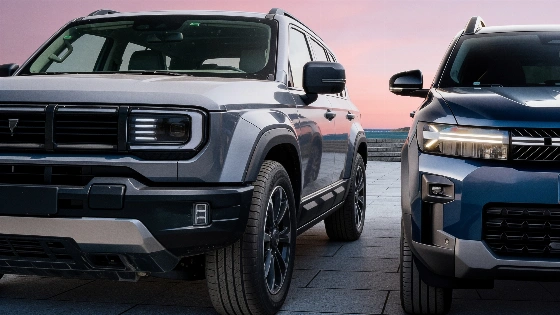
The Santana Cajal and Dacia Bigster take different paths to win over Spanish SUV buyers. One leans on diesel power and off-road tech, the other on efficiency and price. The outcome may surprise anyone shopping for a family car.
The arrival of the Dacia Bigster at just over 25,000 euros has already shaken up Spain’s SUV market. Meanwhile, the Santana Cajal is preparing to launch with a starting price close to 40,000 euros. For families and off-road fans, the question isn’t about brand loyalty anymore—it’s about which approach offers more value.
Both models claim Spanish roots, but their philosophies are miles apart. The Santana Cajal, built in Linares, Jaén, is a full-size SUV aimed squarely at off-road use. It runs on a 2.0-liter turbodiesel engine with 163 horsepower and 390 Nm of torque, paired with an eight-speed ZF automatic and a switchable 4x4 system with low-range gearing. These specs put it in direct competition with established off-roaders, not just city crossovers.
Santana's industrial relaunch in Linares aims for up to 8,000 vehicles per year and around 80 direct jobs, marking a significant return to the Spanish automotive scene.
The Dacia Bigster, on the other hand, is built on the Duster’s platform but stretched for extra space. Its engine lineup is all about efficiency: a 1.2-liter mild hybrid (MHEV) with 140 horsepower, a non-plug-in hybrid (HEV) with 155 horsepower, and a GLP version with up to 150 horsepower and optional 4x4. Every Bigster gets the ECO badge, a nod to Spain’s stricter emissions rules.
On size, the Cajal is the heavyweight: 4,790 mm long, 1,940 mm wide, and 1,915 mm tall, with a 2,760 mm wheelbase. The Bigster is more compact at 4,570 mm long and 1,815 mm wide, but still roomy. When it comes to boot space, though, Dacia pulls ahead. The Bigster’s trunk holds up to 665 liters, and with the rear seats folded, it jumps to 1,930 liters—almost double the Cajal’s 945-liter maximum. For families, that’s a big difference.
Equipment is another key area. Santana Motors promises a digital cockpit, three screens (including one for the front passenger), digital mirrors, a 10-speaker sound system, wireless charging, a panoramic glass roof, power seats with memory, and a 540º camera system. Dacia’s Essential trim includes adaptive cruise control, lane keeping, traffic sign recognition, fatigue alert, emergency braking, a rear camera, 10.1-inch touchscreen, digital instrument cluster, LED headlights, and 17-inch wheels. Santana hasn’t revealed its full equipment list yet, but early signs point to a tech-heavy interior.
According to official Dacia data, the Bigster's fuel consumption ranges from 4.6 to 5.4 liters per 100 km, with CO2 emissions between 104 and 123 g/km depending on the version. This focus on efficiency and ECO labeling is a key part of Dacia's strategy to appeal to Spanish families and comply with urban emission regulations.
For buyers, the environmental sticker matters. The Cajal’s diesel engine only qualifies for the C badge, which limits access to low-emission zones in major Spanish cities. The Bigster’s ECO label, by contrast, gives it an edge for urban drivers as regulations get tighter.
On price, the Dacia Bigster starts at 25,020 euros for the Essential trim with mild hybrid and GLP. The hybrid HEV version is 29,420 euros—still well below the expected Cajal base price. Santana’s final pricing and trims aren’t public yet, but the gap is likely to remain wide.
Performance-wise, the Cajal’s diesel and 4x4 setup will appeal to those who need real off-road ability or plan to tow. The Bigster, with its electrified engines and lighter build, is aimed at efficiency and daily use. This split mirrors what’s happening in other segments, as seen with Toyota’s recent changes in rally models.
In the end, the Santana Cajal is counting on size, ruggedness, and a tech-filled cabin to justify its higher price. The Dacia Bigster focuses on space, efficiency, and affordability. For most Spanish families, the Bigster’s mix of price, boot space, and city-friendly credentials will be tough to beat. Unless Santana Motors surprises with pricing or standout features, the Cajal may struggle to catch up before it even hits the road.