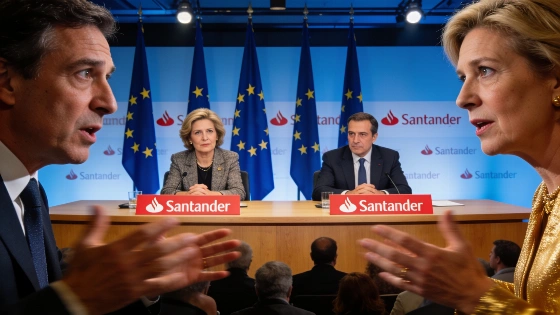
Santander president Ana Botín criticizes excessive EU regulation at the ICEX forum in Madrid. She calls for smarter rules to boost European business competitiveness. Economy Minister Carlos Cuerpo acknowledges the challenge.
Sharp criticism of European regulatory barriers dominated the opening of the ICEX forum in Madrid, where Ana Botín, president of Banco Santander, directly challenged the current pace and complexity of EU rules. Speaking alongside Economy Minister Carlos Cuerpo, Botín argued that the real obstacle for Spanish businesses is not domestic policy, but the weight of European regulation. She described the current regulatory environment as an expensive burden for citizens and warned that unless reforms accelerate, European companies will struggle to compete globally.
Botín emphasized that she supports clear rules, but insisted that Europe has gone too far, creating unnecessary hurdles for growth. She pointed out that Santander invests more in the United States, where a single, unified market allows for easier expansion, while in Europe, companies must navigate the bureaucracy of 27 different economies. According to Botín, this fragmentation slows down business and puts European firms at a disadvantage compared to their international rivals.
In response, Carlos Cuerpo agreed that removing barriers and improving scale is a shared goal. He cited data showing that European companies have invested more in Uruguay over the past decade than in all Eastern European countries combined, despite the larger market size of countries like Poland. Cuerpo acknowledged the need to simplify the regulatory landscape and reduce the number of obstacles businesses face, noting that many of these burdens should be invisible to companies.
The minister highlighted that the Spanish government is closely following recommendations from the report by former Italian Prime Minister Enrico Letta, which outlines a strategic roadmap for revitalizing the EU Single Market. One key proposal is the "Estado 28" project, which would create a single legal and regulatory framework across the EU, allowing companies to operate under one digital window and set of rules, rather than dealing with 27 separate national systems. Cuerpo explained that Spain is already applying similar principles domestically and in cooperation with Portugal to remove cross-border barriers, noting that trade between Spain and Portugal now exceeds that with the United States.
Also present at the roundtable was Óscar García Maceiras, CEO of Inditex, underlining the significance of the discussion for major Spanish businesses. The debate at the ICEX forum reflects broader tensions within the EU over how to balance necessary oversight with the need for agility and competitiveness. These concerns echo recent political debates in Spain, such as those involving the future of government leadership and regulatory direction, as seen in the ongoing discussions about PSOE and Catalan demands highlighted in recent coverage.
For context, the European Union’s regulatory framework is designed to ensure fair competition, consumer protection, and financial stability across member states. However, critics argue that overlapping national and EU-level rules often create duplication and slow down decision-making. Spain, as one of the EU’s largest economies, is particularly sensitive to these issues, given its reliance on exports and the international presence of its leading companies. The debate over regulatory reform is expected to intensify as the EU considers new strategies for economic growth and integration in the coming years.