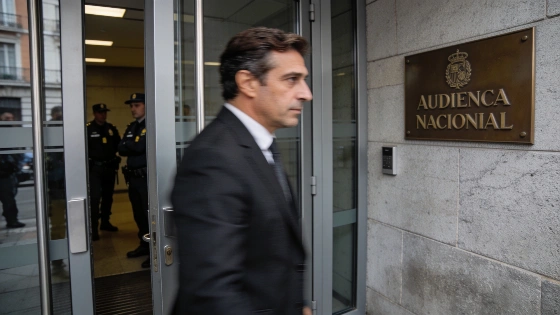
Gonzalo Sanz has reaffirmed his account before Judge María Tardón. He handed over messages and call records linked to warnings before the Ceuta invasion.
On 29 July at 13:52, the CNI sent a warning about calls for an assault on the border fence and by sea at 20:00 the following day. Gonzalo Sanz says that warning reached his former boss, Government delegate Miguel Ángel Pérez Triano. The court now has phone data to test that account.
Sanz, the former chief of staff to the Government delegate in Ceuta, reaffirmed the account in his resignation letter before Judge María Tardón. He submitted messages and call records. The material includes contacts with Pérez Triano and agents of the Centro Nacional de Inteligencia, according to legal sources cited by Libertad Digital.
RTVE reported that Sanz told the court he had "not stopped asking for help." He also handed over data from his phone, including 19 messages with a CNI agent. Sanz appeared as a witness after it became known that he had received the warnings and spoken by telephone with an intelligence agent one day before the invasion.
Sanz told the court that he had 19 messages with a CNI agent who warned about impending mass entries, and submitted the phone data for judicial review.
The central question is narrow. Did information sent by the CNI on 29 July reach Pérez Triano through his chief of staff?
Pérez Triano has publicly said he did not receive information from Sanz. In his resignation letter, Sanz said that claim conflicted with his own account. He cited the dispute alongside personal reasons for leaving the Delegación del Gobierno.
The case now contains more than competing statements. Spanish media reports say investigators have WhatsApp exchanges and a call of about 11 minutes with a CNI agent on the eve of the events. The judge can compare those records with the testimony.
That record matters.
Sanz's testimony concerns the person who represented Pedro Sánchez's Government in the autonomous city during the invasion. Judge Tardón can examine when the messages were sent, what they said and whether they support Sanz's description of the chain of communication. The information may guide the next steps taken by the judge of Central Investigating Court Number 3.
A CNI warning cited by several reports was sent on 29 July at 13:52. It referred to calls on social media for an assault on the border fence and by sea at 20:00 the following day, amid Morocco’s Fiesta del Trono; the warning’s route to the Government is one of the issues under examination.
The testimony follows an earlier appearance by Ceuta president Juan Jesús Vivas. He said he first tried to warn Madrid on 27 July, three days before the mass entry.
Vivas tried to reach the prime minister to explain the danger at the border. He did not speak to him. The Presidency Cabinet took the call instead.
Over the next few days, Vivas kept calling and eventually reached two ministers. Foreign Minister José Manuel Albares told him that Morocco was cooperating with the waves of arrivals and that efforts were under way to stop people entering Spain. The next day, Vivas spoke with Defence Minister Margarita Robles about deploying the Army in Ceuta. Robles was receptive but said the proposal needed analysis.
The dispute reaches beyond one resignation. It concerns which warnings reached the Government and when officials responsible for Ceuta acted on them.
The investigation began in Ceuta and later moved to the National Audience in Madrid. Reports say the court has requested records from the Interior Ministry, police and Civil Guard. The case also examines whether decisions or possible inaction by officials could have influenced the crisis, according to reports.
An earlier report detailed a separate dispute over call records between Ceuta and Moncloa.
For now, the clearest development is the addition of messages and call data to the case. Those records let Judge Tardón compare dates and contacts instead of relying only on later recollections.
The issue is not whether warnings existed. It is how they moved through the Government chain of communication. Sanz's evidence directly challenges Pérez Triano's public account. Prosecutors are also examining whether official decisions or inaction may have affected the development of the crisis.