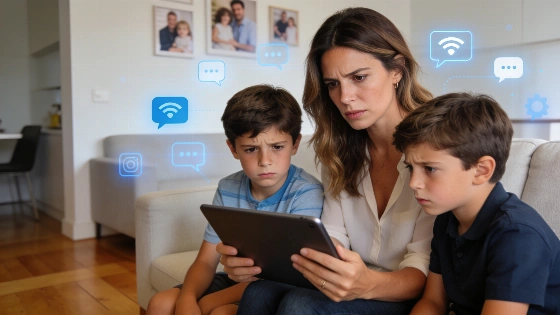
Sara Carbonero has drawn fresh attention to the risks children and teenagers face online, saying the digital environment is not designed with their safety in mind. Speaking as a journalist and a mother, she joined a UNICEF initiative to raise concerns about how digital platforms and social networks affect young people’s well-being.
In a video message, Carbonero said screens and technology are not inherently harmful. The problem, she argued, is the lack of safeguards and age-appropriate design, which leaves minors vulnerable. Responsibility for digital education and protection cannot fall solely to families: algorithms should not dictate children’s mental health and happiness or leave their future to chance.
Research backed by UNICEF in Castilla y León shows how early children encounter digital services. The average age for receiving a first mobile phone was 10.8, while first exposure to pornography averaged 11.6. Among adolescents, 92.2% had an account on at least one social network, and 73.7% were registered on three or more. Researchers cautioned that early exposure without proper guidance can contribute to problematic use and digital violence, while harming emotional well-being.
The regional findings also identified problematic social-network use among 5.1% of schoolchildren, possible gaming disorder among 1.3% and problematic gambling-related behavior among 2.8% of adolescents. Current cyberbullying was reported by 1.4% of pupils, while 9.4% said they had experienced it at some point. The figures show associations, not proof that social media alone causes mental-health conditions: pupils with problematic digital use had poorer quality-of-life indicators, alongside higher levels of anxiety and depression, as well as suicidal ideation.
Exposure is already widespread in late basic school. More than 78% of pupils in the final two years of basic education in Castilla y León had at least one social-media profile, and 40% had profiles on three or more platforms. More than half played video games at least weekly, while nearly one in five said they played every day. Regional reporting also found clear signs of emotional distress in 13% of pupils. Anxiety symptoms affected 12.4%, and depressive symptoms affected 12.2%; 7.3% were classified as having elevated suicide risk. The findings point to a need for supervision and digital education, with safeguards built into the services children use.
Spain’s Ministry for Digital Change and Public Function has opened a public consultation on the proposed EU Kids Act, a structure intended to establish reliable and responsible online environments for minors. The proposal would bar under-15s from independently creating accounts on social networks and video-sharing platforms. Adolescents aged 13 to 15 could use accounts with limited functionality, created and supervised by a parent or legal guardian. In exceptional cases, children under 13 could access age-appropriate video services through guardian-controlled accounts. The measure remains a proposal under consultation, not a final law in force.
Her intervention comes as many Spanish families grapple with setting boundaries and keeping their children safe online. Carbonero’s call for collective action echoes ongoing debates about how technology companies can work with schools and policymakers to create safer digital environments. Regional reporting recommends supervision and support at home, with clear limits, while the proposed EU Kids Act would also put obligations on digital services through age-related access controls and restricted account features.
Alongside her advocacy, Carbonero is spending the summer with her sons, Martín and Lucas, after a particularly challenging year. It included a serious health scare that required emergency surgery in Lanzarote, followed by the loss of her mother, Goyi Arévalo. These personal events have added depth to her public reflections on family and ability to recover.
Health setbacks among public figures have also made headlines recently. Kiko Rivera was forced to suspend his summer tour because of a serious medical issue, affecting numerous scheduled events. More details are available in the report on Kiko Rivera's tour cancellation following a health emergency.
Discussion of digital literacy and child protection continues to grow in Spain, with organizations such as UNICEF pushing for stronger regulations and educational programs. The regional findings document links between problematic digital use and poorer well-being, while the policy debate increasingly considers platform design alongside parental involvement and age controls. As technology evolves and new risks emerge, public figures like Carbonero remain part of the conversation about policy and awareness.