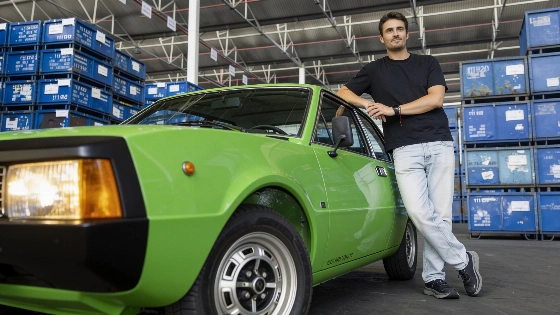
Fifty years ago, the Seat 1200 Sport Bocanegra hit Spanish roads with a look and attitude all its own. Born in Martorell, this lightweight coupé marked a turning point for Seat, showing the world what Spanish engineering could do.
The first time the Seat 1200 Sport Bocanegra rolled out, it didn’t just turn heads—it stopped people in their tracks. That black polyurethane nose, stretching across the front, gave the car its nickname and a look no one could mistake for anything else in 1976. The Bocanegra wasn’t just another model; it was a statement.
Up to that point, Seat’s cars were mostly Italian at heart, built under Fiat’s license. The Bocanegra changed that. Developed at the Martorell Technical Center, it became the first Seat designed and engineered by the company’s own team. This was a clear break from the old way of doing things. Company records show Seat started in 1950 as a Spanish-Italian joint venture, with the first Seat 1400 rolling out in 1953. The Bocanegra’s arrival marked the moment Seat began to step out from Fiat’s shadow.
Seat was founded in 1950 as a Spanish-Italian partnership, and its first car, the Seat 1400, was produced in 1953.
Italian designer Aldo Sessano gave the Bocanegra its sharp, compact shape—3,670 mm long, 1,550 mm wide, and 1,250 mm high, with a 2,220 mm wheelbase. The front bumper, grille, and headlights all merged into that single black mask. It was a bold move for the era. The car didn’t need fake vents or wild lines to stand out. It just did.
Inside, the Bocanegra kept things straightforward. The seats were set low, the dashboard was flat and simple, and the four-speed manual shifter sat close to the driver. Not everything was perfect. The seats were soft, and the pedals sat off to the right, quirks that reminded drivers this was the 1970s and comfort wasn’t always the top priority.
Under the hood, the first Bocanegra used a 1,197 cc four-cylinder engine borrowed from the Seat 124, but mounted sideways—a first for Seat. It made 67 CV at 5,600 rpm and 90 Nm at 3,700 rpm. Those numbers might sound small now, with today’s electrified compacts easily doubling them. But the Bocanegra weighed just 805 kg. That light build, paired with direct steering and a mechanical setup that kept the driver involved, meant the car was more about skill than brute force.
Switching to a transverse engine layout was a big step for Seat’s engineers. The real win wasn’t top speed, but what the team learned along the way. This project set the stage for Seat to design and build cars on its own. Company retrospectives note that Seat’s partnership with Fiat lasted until 1982, but the Bocanegra years showed the brand was ready to go its own way.
Seat’s partnership with Fiat, which began at the company’s founding, lasted until 1982. The period during which the Bocanegra was developed marked the beginning of Seat’s move toward independent design and engineering.
In 1977, Seat launched the Sport 1430, flipping the badge and raising the bar. Its 1,430 cc engine put out 77 CV and 112.8 Nm, bumping top speed from 157 to 165 km/h. That year, a second series swapped in a Weber carburetor for the old Bressel 32 twin-choke. These changes might seem minor now, but back then, carburetion and ignition tweaks could change a car’s whole personality.
The Bocanegra’s toughest rival wasn’t another brand—it was the Seat 128. That car offered similar three-door practicality and engine choices, but with a hatchback and a lower price tag: 245,000 pesetas in 1977, compared to the Bocanegra’s 270,000. For many buyers, the numbers on the invoice mattered more than the romance of a coupé.
Still, the Bocanegra was never built to chase sales records. Between the 1200 and 1430 versions, Seat made 19,332 units by 1979—11,619 of the 1200 and 7,713 of the 1430. The real goal was to prove Seat could design, develop, and build a car with its own resources. In that sense, those 67 CV meant more than any spec sheet could show.
The Bocanegra’s influence didn’t fade when production stopped. Decades later, the black mask returned at the 2008 Geneva Motor Show on the Sport Coupé Bocanegra, which previewed the fourth-generation Seat Ibiza. A special Bocanegra series followed, tied to the FR and Cupra trims, with 4,706 Ibiza Bocanegra units built up to 2012. That black fascia kept its appeal, showing it could still move the needle in the market long after the original’s debut. The story echoes how the Fiat 124’s legacy was explored in a recent retrospective.
Today, a fully restored 1976 Bocanegra in Verde Kent, kept by Seat Históricos, still lines up for regularity rallies. Its almost fluorescent green paint is as much a part of its identity as the black mask. The 13-inch wheels, featherweight chassis, and unapologetic design belong to another era, but the car’s spirit hasn’t faded, no matter how much the industry leans on software and screens.
The Bocanegra’s legacy isn’t about speed or sales charts. It’s about the moment Seat stopped copying Italy and started trusting its own instincts. That choice still echoes today, as the Bocanegra’s bold identity—built on nothing more than a daring black mask—remains something modern cars try to capture, often with more effort and less success.