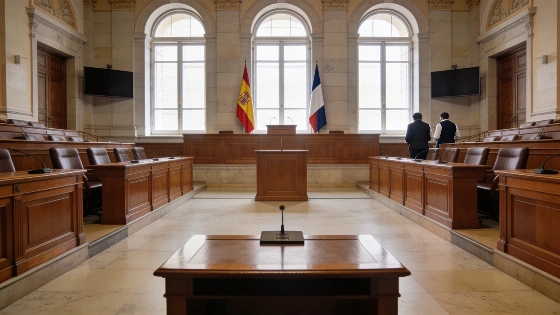
The Government wants the Senate to clear the treaty before Emmanuel Macron visits Madrid. The PP blocked the agreement, but Spain's Constitutional Court has now confirmed that it complies with the Constitution.
Emmanuel Macron is due in Madrid on 29 and 30 September for meetings with the King and Queen, Pedro Sánchez and senior business figures. The Government wants the Senate to ratify the Tratado de Amistad y Cooperación between Spain and France before he arrives.
The treaty could reach next week's plenary agenda on Tuesday and Wednesday. The timing is deliberate.
On 23 September, the Constitutional Court unanimously found no conflict with the Constitution. It also accepted that a French minister's contact with Spain's Council of Ministers would take place separately, not inside the executive meeting.
Emmanuel Macron’s visit on 29–30 September 2026 is expected to be his first state visit to Spain in 17 years.
That ruling removed the legal obstacle that had held up the treaty. Rafael Simancas, Secretary of State for Relations with the Cortes, has asked Senate president Pedro Rollán to give the agreement priority, EL PAÍS reported.
His request relies on Article 71.1 of the Senate's rules. The provision lets the Government's representative add one priority item to the plenary agenda. Normally, the president sets the agenda with the Board and after consulting the Spokespersons' Committee.
If the PP refuses to include the treaty, the Government may seek an extraordinary sitting under Article 70.1. The rule allows the Senate and its committees to meet outside the ordinary calendar. The request can come from the Government, the Permanent Deputation or an absolute majority of senators.
The procedure is already available.
The treaty was signed in Barcelona in January 2023 and received approval from Congress in June 2026. In 2025, the Constitutional Court did not rule on the substance because the text had not yet reached the final ratification stage.
The PP used its absolute majority in the Senate to stop the agreement in July. It sought a Constitutional Court review after Congress approved the treaty in June, despite opposition from the PP and Vox.
Spain and France signed the treaty in Barcelona in January 2023. Congress approved it in June 2026. The Senate then became the next barrier.
The dispute focused on one clause. It would allow a Spanish minister and a French minister to join the other country's cabinet meeting by rotation at least once every three months. France already has comparable arrangements with Germany, Italy and Poland.
The PP argued that the clause breached Article 98 of the Spanish Constitution. That article defines the members of the Government.
In April, José Manuel Albares and his French counterpart Jean-Noël Barrot exchanged interpretive letters. They said the visiting minister would be invited on the margins of the meeting and would attend a separate encounter.
The PP still asked the highest interpreter of the Constitution for a ruling. It presented the challenge as a matter of legal certainty.
The court has now answered that argument. Its ruling refers to the exchange of letters and says the French minister's invitation would not create participation in a Spanish Council of Ministers meeting.
RTVE and Europa Press reported that the unanimous decision treated the proposed contact as a separate meeting held alongside, not within, the Council of Ministers.
The agreement is the first friendship and cooperation treaty between Spain and its main neighbour and leading trading partner worldwide, according to the Government's description. Madrid wants ratification to coincide with Macron's visit.
The King and Queen are expected to host Macron at a gala dinner. The Élysée has confirmed the 29-30 September programme and said Paris wants the ratification process completed.
Macron will not address the Senate during the state visit, despite an offer from Spain. Sources in Congress and the Government have linked that decision diplomatically to the PP's blocking of the treaty.
That adds pressure on La Moncloa.
If the Senate puts the treaty on its agenda and approves it, ratification could be completed within days. A new PP blockade could lead the Government to seek an extraordinary sitting under the chamber's rules.
If the Senate still rejects the procedure, the text could return to Congress under the parliamentary process described by Spanish media. The treaty also carries symbolic weight as a framework for a special partnership between Spain and France, similar to arrangements France has with other European countries.
The constitutional question is settled. The Tribunal Constitucional has ruled.
The Senate must now decide whether its majority will let the bilateral agreement move forward before a high-profile state visit. The Government is using a procedure already set out in the rules. Further obstruction would be a political choice, not a response to an unresolved legal issue.