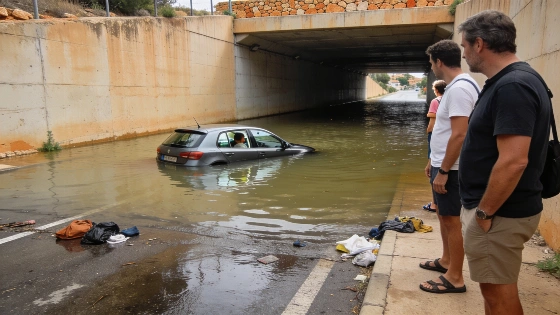
Heavy overnight rains on the Costa Daurada left parts of Baix Penedès flooded. Emergency services rescued trapped motorists and relocated affected families. Tourists lost vehicles and accommodation as local infrastructure struggled.
Overnight torrential rains have caused significant disruption along the Costa Daurada, with the Baix Penedès region experiencing severe flooding, material damage, and injuries. Emergency services responded to dozens of incidents as water levels rose rapidly, leaving both residents and tourists stranded or displaced.
In several municipalities, rainfall reached up to 200 litres per square metre within hours, overwhelming drainage systems and flooding roads. Among the most affected were families staying in local campsites, some of whom found themselves trapped in vehicles as water surged through low-lying areas. One such case involved Xavi Peñarroya from Barcelona, whose family holiday in Creixell was abruptly interrupted when their car became stuck in a flooded tunnel while returning from a nearby concert. Local police intervened, helping the group escape through the car windows before transferring them to the municipal police station.
With only two officers on duty and a surge in emergency calls, police resources were stretched thin. According to Peñarroya, officers had to leave the station repeatedly to assist other motorists trapped by rising waters. The family, along with other affected individuals, was later moved to the Casal Municipal, which was set up as a temporary shelter for those displaced by the floods. Local authorities, including the mayor Montserrat Muñoz, faced questions about why the tunnel had not been closed to traffic and why warning alerts were not issued to all campsite guests, despite prior notifications to site operators.
As the situation unfolded, Civil Protection was called in to provide additional support, including 4x4 vehicles to navigate submerged areas. The aftermath left families unable to recover their belongings, with vehicles still submerged and personal items lost or scattered. Peñarroya’s car remained in the tunnel, visible only by its roof and partially submerged windows, while local children swam around the stranded vehicle, drawing attention from passersby.
Flooding of this scale is not unprecedented in the region, but the intensity and speed of the rainfall caught many off guard. The Costa Daurada, a popular destination for both Spanish and international tourists, relies heavily on its infrastructure to manage seasonal weather events. However, as seen in this incident, rapid water accumulation in vulnerable zones such as tunnels and underpasses can quickly overwhelm local response capabilities. Spanish authorities have previously urged municipalities to review emergency protocols and improve communication with residents and visitors, especially during peak holiday periods. The incident highlights ongoing challenges in adapting to increasingly unpredictable weather patterns, which experts link to broader climate trends affecting the Mediterranean basin.