Heavy storms with hail have triggered major transport disruptions in Catalunya. Multiple rail lines and roads are closed. Authorities urge caution as emergency plans are activated and crop losses mount.
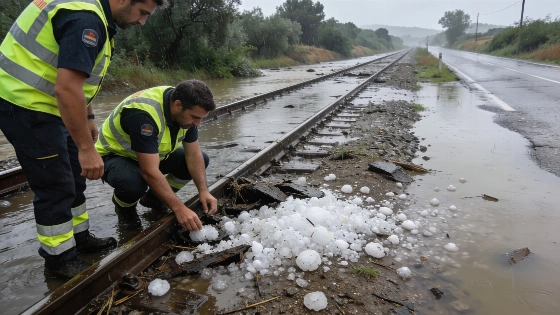
Intense storms swept through Catalunya on Thursday, unleashing torrential rain and hail that forced the closure of key rail lines and roads, while causing significant damage to agriculture. The disruption began early in the day, with Rodalies suspending service on the R11, RL4, and R3 lines due to storm impacts. By late afternoon, Protecció Civil had escalated the emergency response, placing the Ferrocat plan on pre-alert and confirming that seven rail lines were affected, including R1, R2 north, R11, RG1, R13, R14, and R3. The R11 line between Maçanet and Girona was among the hardest hit, with Renfe deploying replacement buses to Figueres and offering seats on Avant services for travelers between Girona and Barcelona in both directions.
Rail infrastructure suffered further setbacks as fallen trees blocked the R3 line between Vic and Ripoll, prompting Renfe and Adif to extend alternative road transport. The RL4 line was also cut between Calaf and Manresa after a swollen stream made the tracks impassable. Road alternatives were hampered by flooding, with ongoing bus services between Fabra i Puig and La Garriga, Centelles, and Vic. The Servei Català de Trànsit reported the N-145 road near the Andorra border was closed due to a landslide of rocks and mud, while single-lane closures were enforced on the C-63 in Brunyola and the C-25 in Rajadell because of standing water.
Rainfall totals reached exceptional levels in several areas. Isòvol in Cerdanya recorded 71 liters per square meter, Fals in Bages saw 62, and Sant Salvador de Guardiola registered 58 liters by early evening. Meteocat warned that the storms would shift south overnight, with violent weather alerts issued for Alt Camp, Cuenca de Barberà, Garrigues, Pla d'Urgell, Segrià, and Urgell. The president of the Generalitat, Salvador Illa, called for maximum caution, especially during travel, and urged residents to follow emergency instructions, avoid rivers and flood-prone areas, and not to park in zones at risk of inundation.
Hailstorms struck numerous towns, with residents sharing images of agricultural devastation on social media. In Sant Joan Les Fonts, hailstones over 4 cm in diameter blanketed streets, leaving local farmers and residents reporting heavy losses. Emergency services received 300 calls and responded to 115 incidents by 8 p.m., mostly for flooded basements, blocked drains, fallen branches, and securing public infrastructure. The hardest-hit areas for emergency calls were Vallès Oriental, Bages, and Selva.
By late afternoon, the storms reached the central pre-coastal region and Barcelona, bringing intense rainfall to Vallès Oriental. Earlier, heavy showers and hail had battered the Pyrenees, northern Ripollès, Andorra, and Cerdanya. According to Santi Segalà, head of forecasting at the Servei Meteorològic de Catalunya (SMC), the episode was expected to subside around midnight, but the risk of slow-moving, locally intense storms remained. The Inuncat emergency plan for flood risk, activated the previous day, stayed in force as authorities warned that more than 40 liters per square meter could fall in just 30 minutes across much of the region, with some areas potentially exceeding 90 liters in three hours. The SMC rated the danger level at 4 out of 6, citing the likelihood of violent phenomena such as strong winds, hail, and downbursts.
While Catalunya faced widespread disruption, other parts of Spain have also experienced emergency situations this summer. For example, Ceuta recently struggled to cope with a surge of over 1,000 migrants arriving by sea, overwhelming local shelters and prompting urgent coordination between authorities, as detailed in this report on the recent migration crisis in Ceuta. Such events highlight the growing challenges posed by extreme weather and humanitarian pressures across the country.
Storm-related emergencies are not uncommon in Spain, especially during the summer months when sudden downpours can lead to flash floods and infrastructure damage. The combination of heavy rainfall, hail, and strong winds often results in significant agricultural losses, particularly in regions like Catalunya where fruit and vegetable production is vital to the local economy. Authorities typically respond by activating emergency plans, deploying alternative transport, and issuing public safety warnings. Residents are advised to monitor official channels for updates and to take precautions during severe weather events, as the risk of rapid flooding and transport disruption remains high in affected areas.