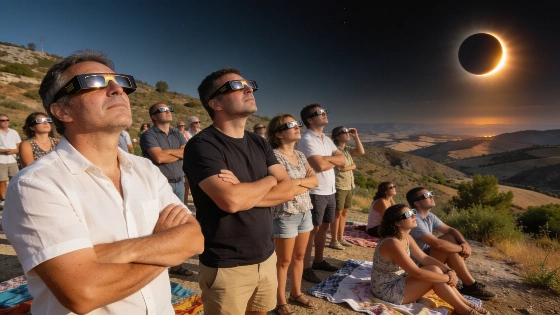
On August 12, Spain will witness a rare solar eclipse. The path of totality will cover 40% of the country. Local authorities urge residents to plan ahead to avoid congestion and ensure safe viewing.
Spain is preparing for a significant astronomical event on August 12, when a solar eclipse will sweep across the country, offering a rare spectacle that will not be experienced equally everywhere. The path of totality—where the Moon will completely obscure the Sun for nearly two minutes—will stretch over approximately 40% of Spanish territory, making it the most extensive such event in recent decades.
According to the interactive map published by EL PAÍS, the eclipse will be visible in varying degrees across the nation. While some regions will experience total darkness for a brief period, most of the country will see only a partial eclipse, with the percentage of solar coverage and duration depending on the specific location. The map details not only the exact times and levels of obscuration for each municipality, but also highlights the central line, which marks the optimal viewing spots where the eclipse will last the longest.
The shadow's trajectory will cross 13 of Spain's 17 autonomous communities and affect at least 31 out of 50 provinces. This means a large majority of residents and visitors will have the opportunity to observe the phenomenon, though only those within the totality band will witness the full effect. In these areas, the experience of sudden darkness is expected to be both brief and striking.
Authorities are urging those in the totality zone to select observation points close to home, aiming to prevent unnecessary travel that could lead to traffic congestion or other logistical issues on the day of the eclipse. For those outside the optimal viewing areas, local councils and regional governments are designating official viewpoints capable of safely accommodating large gatherings. These locations can be found on the map provided by EL PAÍS, which also includes a shadow overlay to indicate whether the Sun will be visible at the peak of the eclipse or blocked by local terrain.
In Madrid, for example, concerns about crowd management and safety have already led to the cancellation of several public viewing events, as highlighted in a recent report on how only 30 out of 52 municipalities maintained their eclipse plans due to wildfire risks. More details on these local measures can be found in this coverage of Madrid's eclipse event cancellations.
Solar eclipses are rare in Spain, with the last total eclipse visible from the mainland occurring in 2005. The upcoming event is expected to draw significant public interest, especially in regions within the path of totality. Experts recommend using certified eclipse glasses or indirect viewing methods to protect eyesight, as looking directly at the Sun can cause permanent damage. The next opportunity for a similar event in Spain is not expected for several decades, making this eclipse a unique occasion for both residents and tourists. Local authorities continue to update guidance and logistical information as the date approaches, emphasizing safety and responsible participation.