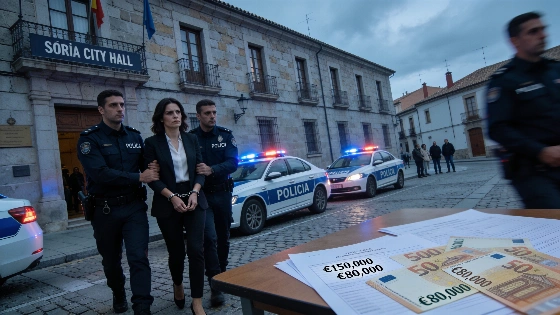
Soria’s environment councillor, Yolanda Santos, was arrested for corruption. Her former company received over €226,000 in municipal contracts after she took office. The case raises questions about public procurement in small Spanish cities.
The Soria City Council has come under scrutiny after awarding more than €226,000 in contracts to Biosfera Soria SL, a company previously managed by Yolanda Santos, the current councillor for the environment who was arrested this week on corruption charges. The contracts, granted between 2019 and 2026, have triggered a judicial investigation and renewed debate over the boundaries between public office and private business in smaller municipalities.
According to official records, Biosfera Soria SL secured three public tenders totaling €131,549.25 and eight smaller direct contracts worth €95,049.83 from the council after Santos left her managerial role to join the local government in 2019. The company, active since 2007 and focused on nature and leisure activities, continued to win municipal work even after changes in its management. The most recent contracts covered environmental education, family support programs, and the management of local facilities.
Santos was detained alongside five others, including former company associates and her husband, as part of a broader investigation led by Soria’s Court of First Instance No. 3. The charges under review include influence peddling, administrative misconduct, prohibited negotiations by public officials, document falsification, money laundering, and alleged involvement in a criminal organization. While Santos was brought before a judge, the other detainees were released pending further inquiry.
The case has prompted a swift response from local and regional political leaders. Carlos Martínez, Soria’s former mayor and a prominent figure in the PSOE, expressed confidence in the legality of the council’s actions, noting the limited pool of companies able to deliver specialized services in a city of 41,000 residents. The current administration, led by Javier Antón, has suspended Santos from her duties and announced plans to join the legal proceedings as an interested party. An internal review has also been launched to clarify the circumstances surrounding the contracts.
Management of Biosfera Soria SL shifted several times after Santos left the company. Marta Viu Cuerda, the first administrator, departed in 2010 and now works in the Ministry for Ecological Transition. After Santos’s exit in 2019, Araceli Soler and María Cristina Martínez, a councillor from Arévalo de la Sierra, took over until August 2020, when Ángela Blázquez assumed the role. The company also secured contracts from the Junta de Castilla y León, including agreements for visitor services at the Bosque de El Amogable, valued at €75,500 and €28,700 for different periods.
Sources close to the investigation suggest that the main issue lies in the lack of a clear separation between Santos’s former business interests and her public responsibilities. Critics argue that, in small municipalities, such overlaps are difficult to avoid but can create the appearance of impropriety. The Popular Party previously questioned the relationship between Biosfera Soria and the council but did not pursue the matter politically at the time.
The investigation remains under judicial secrecy, with few details released. The case highlights ongoing challenges in public procurement and transparency in Spain’s smaller cities. Similar concerns about the allocation of public funds and the risk of vulnerable groups missing out on social support have been raised in other regions, as seen when Catalonia allocated €30 million to identify families not receiving social aid, detailed in this report on targeted welfare initiatives.
For context, Spanish law requires public officials to avoid conflicts of interest, but enforcement can be complex in local administrations with limited resources. The outcome of the Soria case may influence future guidelines on municipal contracting and the oversight of former business ties among elected officials.