The Spanish government will provide Ceuta with €25 million in extra funds. The measure aims to address the sharp rise in unaccompanied migrant minors. Local authorities warn the real number of children needing help may be even higher.
The Spanish government has approved an extraordinary allocation of €25 million to help Ceuta manage the sudden influx of unaccompanied migrant minors. The announcement was made in Madrid by Elma Saiz, Minister of Inclusion, Social Security and Migration, who emphasized that this funding comes in addition to the €5.5 million distributed to Ceuta last July as part of a broader €35 million package for Spain’s autonomous communities.
Ceuta’s authorities have been under mounting pressure since last Thursday, when thousands crossed the border from Morocco. While the Ministry of the Interior estimates that over 60,000 people have entered the enclave and at least 90 have died, the exact number of unaccompanied minors remains unclear. The local government, led by Juan Vivas, reports caring for 862 migrant children but believes the true figure could exceed a thousand, as some minors are still unaccounted for on the streets.
Minister Saiz underlined that the new funds are intended to reinforce Ceuta’s capacity to provide care and protection for these vulnerable children. She also called on all Spain’s autonomous communities, including those governed by the Partido Popular, to share responsibility for the reception and care of migrant minors. According to the Ministry of Youth and Children, Article 35 of Spain’s immigration law requires other regions to participate in the binding and solidarity-based reception of minors who arrive in Spain irregularly.
Sira Rego, Minister of Youth and Children, announced plans to travel to Ceuta in the coming days to coordinate the response on the ground. The ministry’s goal is to activate all available mechanisms to ensure dignified accommodation for the newly arrived children and adolescents. The recent reform of the immigration law also allows for agreements with NGOs and foundations specializing in child protection, as well as family reunification for minors with relatives in their countries of origin, provided it serves the child’s best interests.
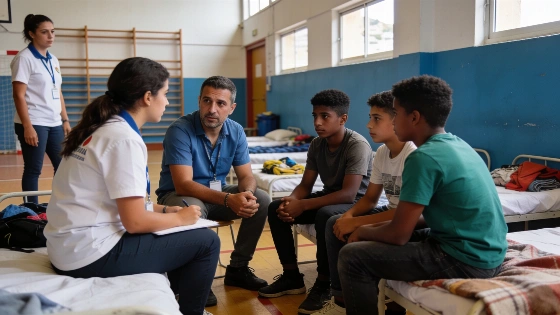
Efforts are underway to individually identify each minor, a step officials say is essential for accurate reporting and for transferring children to appropriate child protection facilities. In the meantime, two local schools will be converted into temporary shelters to accommodate the latest arrivals, as Ceuta remains in a state of extraordinary migration contingency since August 2025.
Many of the minors initially spent nights outside a warehouse near the El Tarajal border, which has since been adapted to provide emergency shelter. According to Alberto Gaitán, Ceuta’s Councillor for the Presidency and head of the Minors Department, the children are now being relocated to safer facilities. The city’s resources, however, remain stretched, and the situation is evolving rapidly.
This crisis echoes previous emergencies in Ceuta, where authorities have repeatedly struggled to cope with sudden surges in arrivals. As highlighted in a recent report on the city’s urgent conversion of industrial spaces for child migrants, the pressure on local infrastructure and services has been mounting.
Spain’s approach to unaccompanied minors is shaped by both national and EU regulations, which prioritize the best interests of the child and require member states to provide adequate care. Ceuta’s unique position as a border enclave makes it a frequent entry point for migrants from North Africa, often resulting in humanitarian challenges that test the limits of local and national support systems. The new funding aims to stabilize the situation, but the scale of arrivals and the complexity of individual cases mean that the response will require ongoing coordination between local, regional, and national authorities.