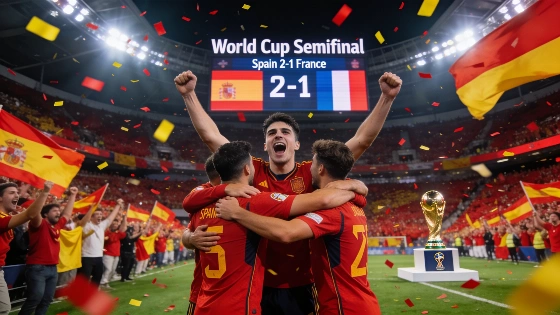
Spain has advanced to the World Cup final for only the second time. The national team overcame France, previously seen as favorites, with a commanding performance. Former players praised Spain's collective strength and tactical superiority.
Spain has secured a place in the World Cup final for just the second time, overcoming France in a match that challenged pre-game expectations. The Spanish team, now just 90 minutes away from a potential second world title, delivered a performance that drew widespread recognition from former international stars. France entered the semifinal as the presumed favorite, but Spain's tactical discipline and team cohesion shifted the balance decisively.
Throughout the match, Spain maintained control both in possession and in defensive organization. Observers noted that the Spanish side consistently outmaneuvered France, with several ex-players highlighting the collective nature of Spain's approach. Notably, the contributions of Oyarzabal and Cucurella were singled out, with many pointing to their resilience and effectiveness against France's high-profile attackers. The ability of Cucurella to manage the pressure, especially after receiving an early booking, was described as a key factor in neutralizing threats from Olise and Dembélé.
Former professionals such as Henry, Ibrahimovic, McManaman, Owen, Troy Deeney, and Gary Neville offered their perspectives on Spain's display. They emphasized that Spain's strength lies not in individual brilliance but in the unity and adaptability of the squad. Rodri's return to form after injury was also noted as a significant boost, with his leadership in midfield seen as instrumental to Spain's progress. The consensus among these voices was that Spain's dominance left France with few answers, and that future opponents would need to raise their level considerably to compete.
The result has sparked discussion about the shifting balance of power in international football. As Spain prepares for the final, attention turns to whether England or Argentina can match the intensity and organization shown by the Spanish side. The semifinal outcome also follows recent tensions between Spain and France, which were highlighted in the run-up to the match. For context, a recent article by Mariano Rajoy led to a diplomatic dispute between the two countries, as detailed in this report on the Spain-France World Cup rivalry.
Spain's journey to the final comes 16 years after their previous appearance at this stage. The team's evolution since then has been marked by a renewed focus on collective play and tactical flexibility. The current squad's ability to adapt to different challenges has been a defining feature of their campaign. As the final approaches, the spotlight remains on whether Spain can secure a second star and further cement its place among football's elite. The outcome will not only shape the legacy of this generation but also influence the perception of Spanish football on the global stage.