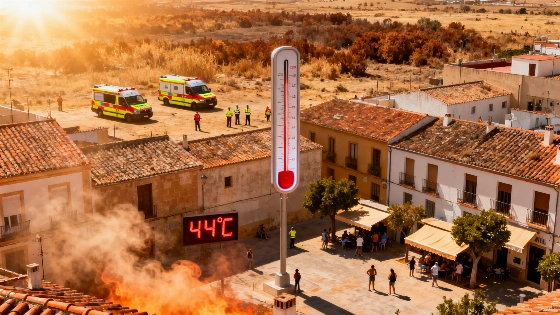
Spain is experiencing its earliest summer heatwave, with record temperatures and health risks. Nearly half the population is under alert as authorities respond to the escalating impact of climate change.
Spain has entered its first major heatwave of the summer, with meteorological data confirming record-breaking temperatures for June. The Agencia Estatal de Meteorología (Aemet) forecasts that this week will bring the hottest June days since at least 1950, marking a new milestone in the country’s climate history. The heatwave, which began on Sunday, follows an already unusually warm June and a late May that saw extreme temperatures across much of Spain and Western Europe.
Authorities have responded by activating health alerts in 86 isoclimatic zones, covering 5,266 municipalities and nearly 21.9 million residents—about 46% of Spain’s population. The Ministry of Health has issued warnings to regional and local governments, urging them to inform the public about the risks. The recent spike in temperatures has already had deadly consequences: the late May heat event resulted in 101 deaths, the highest toll for that month since the MoMo monitoring system began in 2015.
This heatwave is not limited to mainland Spain and the Balearic Islands; much of southern and western Europe, especially France, is also affected. The Canary Islands remain largely untouched. According to Aemet, heatwaves are now arriving earlier each year, a trend linked to climate change. Between 1975 and 2000, only two June heatwaves were recorded in mainland Spain. That number has jumped to ten between 2000 and 2025. The start of the heatwave season is advancing by about four days per decade, resulting in longer periods of extreme heat.
Heatwaves are defined by Aemet as periods of at least three consecutive days when at least 10% of reference weather stations record maximum temperatures above the 95th percentile for July and August. Analysis of the past 50 years shows that 40% of all heatwaves in mainland Spain have occurred since 2015. Their duration has also increased: in the last decade, the average heatwave lasted 7.2 days, compared to five days in the previous four decades—a 30% increase.
Behind these extreme events lies a broader trend of global warming. Carlo Buontempo, director of the Copernicus Climate Change Service, notes that the past 11 years have been the warmest on record worldwide. In Spain, the last four years have been the hottest since records began, with the national average temperature rising by 1.75 degrees Celsius since 1961. These rapid changes are attributed mainly to human-driven greenhouse gas emissions, particularly from fossil fuel combustion.
Research published in Nature in September examined 213 historical heatwaves worldwide between 2000 and 2023. The study found that all were intensified by global warming, and a quarter would have been nearly impossible without current temperature levels. In Spain, eight major heatwaves—including the extreme summer of 2022—were analyzed, with findings indicating that such events would not have occurred without the present degree of warming.
Last summer tied with 2022 as the hottest on record in Spain and was marked by three severe heatwaves. The final heatwave, lasting 16 days, contributed to devastating wildfires in August that destroyed over 300,000 hectares—the worst since the 1990s. Earlier heatwaves had already dried out vegetation, setting the stage for these fires. Experts are closely watching the end of June 2026 to gauge the potential severity of this year’s wildfire season, though predicting fire activity remains complex due to multiple influencing factors.
Globally, 2024 is currently the hottest year on record, but this could soon be surpassed as the El Niño phenomenon develops, potentially pushing global temperatures even higher. According to Buontempo, another global temperature record is likely within the next 12 to 18 months, possibly as soon as 2026 or 2027.
For context, Spain’s vulnerability to heatwaves is heightened by its geography and climate. The country’s population density in urban areas, aging demographics, and reliance on outdoor labor increase health risks during extreme heat. The government’s alert system, coordinated through Aemet and the Ministry of Health, is designed to mitigate these risks by providing timely information and activating emergency protocols. As heatwaves become more frequent and intense, adaptation measures—such as urban cooling strategies and public health campaigns—are becoming increasingly important for Spanish cities and regions.