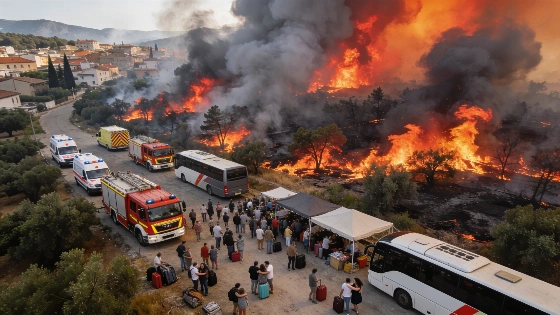
Wildfires have forced over 73,000 people to leave their homes in four provinces. Authorities declared a national emergency. Nearly 171,000 residents are affected by evacuations and confinement.
Spain is experiencing its most extensive evacuation of the century as wildfires continue to devastate Ávila, Madrid, Toledo, and Castellón. More than 73,000 residents have been forced to leave their homes, with the crisis affecting nearly 171,000 people through evacuations and mandatory confinement. The Ministry of the Interior took command after declaring a national emergency, a measure rarely used and last seen during the 2025 blackout.
The scale of the displacement is unprecedented in recent Spanish history. The number of evacuees now surpasses the populations of entire provincial capitals such as Palencia or Ciudad Real. For comparison, the 2011 Lorca earthquake led to 30,000 people spending the night outside their homes, but only a third were officially evacuated. The eruption of the La Palma volcano displaced 7,800, and even the catastrophic Tous dam disaster in 1982, with its unclear figures, may not have matched the current numbers.
Evacuations have been swift and widespread. In La Adrada (Ávila), alarms sounded on mobile phones, prompting authorities to organize buses for the elderly and dependent residents, and to check every house to ensure no one was left behind. In Aldea del Fresno (Madrid), residents received evacuation orders on Thursday evening and, as of the latest reports, had not been allowed to return. The situation remains tense in dozens of municipalities, with Madrid accounting for 31,865 evacuees, Ávila 25,087, Toledo 6,200, and Castellón 10,000. Late on Sunday, some Toledo villages were cleared for return, but the exact number of returning residents was not specified.
Beyond those evacuated, nearly 98,000 people are confined to their homes: 19,062 in Madrid, 8,735 in Ávila, and 70,000 in Castellón. The fires originated in Burgohondo (Ávila), the western Sierra of Madrid, and Vall d'Uixó (Castellón), affecting densely populated areas rather than the sparsely inhabited regions typically hit by wildfires. This has complicated evacuation logistics and increased the number of people at risk.
Emergency teams, volunteers, and local authorities are working around the clock. Many residents, exhausted from days in temporary shelters, are anxious about the fate of their homes. In the Valle del Tiétar (Ávila), some tried to return to help fight the flames but were stopped by the Guardia Civil, who maintain strict controls at town entrances. Volunteers who remained focused on creating firebreaks to protect urban areas, but fatigue is mounting, and relief rotations are urgently needed. Local governments are coordinating supply deliveries to support those on the front lines.
Guardia Civil commanders acknowledge the frustration of not being able to assist all residents who chose to stay behind despite evacuation orders. With limited resources, their priority is the safety of those who have left and the ongoing evacuation and rescue operations. The crisis has highlighted a longstanding issue: the shortage of law enforcement personnel in rural areas, which becomes critical during large-scale emergencies.
According to the latest figures, the fires have destroyed approximately 85,500 hectares: 50,000 in Ávila—making the Burgohondo fire the largest in the region's history—25,000 in Madrid, 2,000 in Toledo, and 8,500 in Castellón. The most concerning fronts remain in Mijares and Casillas (Ávila) and the northern area of the San Juan reservoir (Madrid). While some improvement was noted in Ávila, the situation near the reservoir remains volatile. Authorities warn that a new heatwave expected from Wednesday could further complicate firefighting efforts, urging the public to act responsibly.
This emergency follows a series of severe wildfires in Spain in recent years. In August 2024, mass evacuations in Ávila and Madrid also made headlines, with thousands seeking shelter in temporary facilities. For a closer look at how communities coped during those earlier evacuations, see the report on Talavera fairgrounds hosting evacuees from Ávila and Madrid.
Spain's vulnerability to wildfires has increased due to a combination of climate factors and demographic shifts. The growing frequency and intensity of fires have put additional pressure on emergency services and exposed gaps in rural infrastructure and preparedness. As the country braces for another heatwave, the focus remains on containing the current fires and ensuring the safety of thousands still displaced or confined.