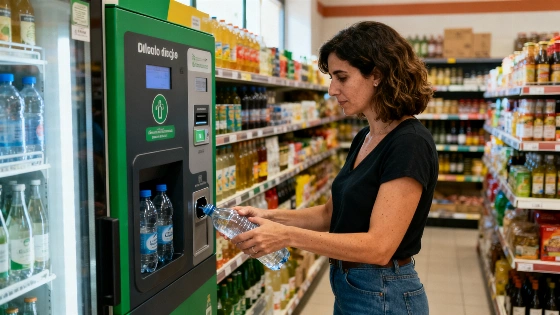
From November 2026, a deposit will be charged in Spain for each bottle and can. Spain is changing its beverage purchasing rules: starting November 2026, the price of every bottle or can will include a refundable deposit. The new system will affect shops, bars, and restaurants, aiming to increase packaging recycling rates.
Starting November 2026, buying drinks in Spain will change: a refundable deposit will be added to the price of every bottle or can. This applies to all points of sale — from supermarkets to bars and restaurants. The deposit will be 10 cents per unit of packaging, and you can get this money back by returning the empty container at any location participating in the system.
Authorities are introducing the so-called SDDR — a system of deposit, return, and reuse of packaging. The idea is simple: the customer pays a bit more, but gets the deposit back when returning the bottle or can. This approach already works in Germany, Denmark, and Portugal and has proven effective in reducing waste.
Why is Spain taking this step
The reason is the low collection rate of plastic containers. According to European statistics, in 2023 Spain managed to collect only 41.3% of plastic bottles, while the EU requires a minimum of 70%. The gap is significant, and if the situation doesn't improve, the country risks sanctions from Brussels.
The yellow container system, which has been emphasized in recent years, has not delivered the desired results. Now the authorities are betting on an economic incentive: if packaging becomes 'money', throwing it away simply doesn't make sense.
What will change for stores and cafes
All retail outlets selling beverages in packaging will be required to accept empty containers for return—even if the product was purchased elsewhere. Special machines and return points will be set up for this, where it will be enough to scan the barcode and receive the deposit back. This applies to both large chains and small shops, as well as catering establishments.
Customers will need to keep their empty bottle or can and return it to any convenient collection point. The return process is promised to be as simple and fast as possible.
How this will affect daily life
For most consumers, the new system means that throwing away packaging will no longer be advantageous: if the container is not returned, the deposit remains with the seller. At the same time, for those already used to sorting waste, the procedure will become even easier—now there will be direct compensation for it.
According to estimates from European countries where a similar system is already in place, the rate of collection and recycling of packaging increases sharply. This not only reduces the environmental burden but also saves resources.
As Talent24h notes, the transition to a deposit-return system is a necessary step prompted by European standards and the need to catch up with neighboring countries in terms of recycling rates. In the coming years, Spain aims to reach the required indicators and avoid fines from the European Union.