Spain has reinstated border checks for travelers from Italy. Police now inspect documents for 5–10% of passengers on selected flights. The move follows Italy’s refusal to lift its own restrictions on Spanish arrivals.
Spanish authorities have reintroduced border controls for passengers arriving from Italy, with police now conducting random document checks at major airports. The measure, which took effect at midnight, was triggered by Italy’s decision to maintain its own restrictions on Spanish travelers. According to the Ministry of the Interior, around 100 National Police officers have been deployed to supervise flights from Italy, focusing on airports in Madrid, Barcelona, Málaga, Seville, Bilbao, Alicante, and Valencia. The checks are expected to expand to the Balearic and Canary Islands later in the day.
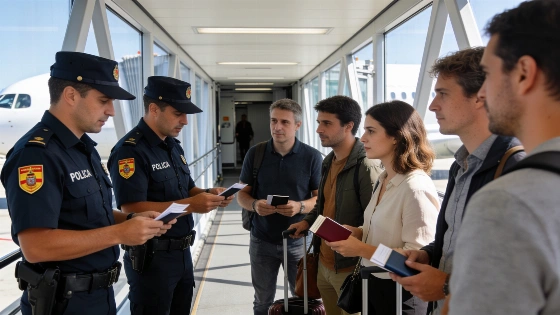
Under the new protocol, police officers review the documents of only 5% to 10% of passengers on each flight, selecting individuals at random. On medium-sized aircraft, this typically means about 15 people are checked, while larger planes see around 25 passengers inspected. The process takes place at the exit of the jet bridge, avoiding the usual external border control areas. Officers primarily target non-EU nationals, verifying passports, visas, or residence permits as required by Schengen rules. EU citizens are generally exempt to speed up disembarkation, but those without proper identification may be taken aside for further verification.
The government’s decision follows Italy’s refusal to lift border checks imposed after a surge of migrants entered Ceuta, a Spanish enclave outside the Schengen Area. Spain’s response mirrors Italy’s approach, with Interior Minister Fernando Grande-Marlaska formally notifying EU officials of the temporary measure. The controls are set to remain in place until at least September 7, though the timeline may change depending on developments. The Ministry cites concerns over migration pressure on the central Mediterranean route and the risk of cross-border criminal activity as justification for the move.
At Barcelona’s El Prat airport, the implementation has varied. Some flights, such as those from Rome, saw Italian passengers separated and asked for documents, while others, like arrivals from Bologna, reported no checks at all. Police sources at the airport indicated that the focus is on non-EU nationals suspected of boarding in Italy to enter Spain. Travelers without Spanish ID have been escorted to separate rooms for identification. The process has generally been described as calm, with most passengers experiencing little disruption.
Maritime arrivals are also affected, with random checks planned for cruise passengers docking in Barcelona. The list of Italian airports subject to these controls includes Rome’s Fiumicino and Ciampino, Milan’s Malpensa, Naples, Venice, and Florence, with more to be added soon. The Ministry uses Passenger Name Record (PNR) data from airlines to decide whether to check all passengers on a given flight or only a subset. When doubts arise about a traveler’s eligibility, they are referred to the border post for further examination and possible denial of entry.
The Italian opposition has criticized Prime Minister Giorgia Meloni’s government for maintaining restrictions on Spanish travelers, arguing that it has sparked an unnecessary diplomatic dispute and harmed Italian citizens. Some politicians have called for an immediate end to the suspension of Schengen rules, especially after Spain’s reciprocal action. The situation has drawn attention across Europe, with previous tensions highlighted in reports such as Spain’s warning to Italy over border controls.
Spain’s move to restore border checks is permitted under the Schengen Borders Code, which allows temporary controls in response to serious threats to public order or internal security. Such measures have become more common in recent years amid migration pressures and security concerns. The current checks are not systematic and are designed to minimize disruption for most travelers, but they mark a significant shift in travel between Spain and Italy. The government will reassess the need for continued controls at the end of the initial period, taking into account the evolving migration situation and any changes in Italy’s policy.