On 12 August 2026, Spain will witness its first total solar eclipse of the 21st century. The event will be visible across much of the country, drawing global attention and requiring careful preparation for safe viewing.
Spain is set to become the focal point for astronomers and skywatchers on 12 August 2026, when the first total solar eclipse of the 21st century visible from the Iberian Peninsula will occur. The phenomenon, expected at sunset, will allow millions across the country to experience a rare moment of complete solar obscuration, a spectacle not seen in continental Europe since 1999.
According to Miguel Querejeta, astrophysicist at the Real Observatorio de Madrid, the uniqueness of this eclipse lies in its totality being observable from Spain—a rarity, as most solar eclipses are either partial or only fully visible from remote locations. The last comparable event in Europe took place 27 years ago, underlining the exceptional nature of the upcoming eclipse.
The path of totality, where the Moon will entirely cover the Sun, stretches from the Cantabrian coast through central Spain to the Mediterranean, including the Balearic Islands. Regions such as Galicia, Asturias, Cantabria, Castilla y León, La Rioja, much of Aragón, southern Catalonia, northern Comunidad Valenciana, and the Balearics are all within this band. However, weather conditions could affect visibility, with the Meseta—areas like Burgos, Valencia, Soria, southern Zaragoza, and Teruel—offering a higher chance of clear skies in August.
Duration of totality will peak at around one minute and 50 seconds near the center of the band, gradually decreasing toward the edges. Observers outside this zone, including those in Madrid, will experience a near-total eclipse, but only within the path of totality will the sky darken dramatically and the solar corona become visible.
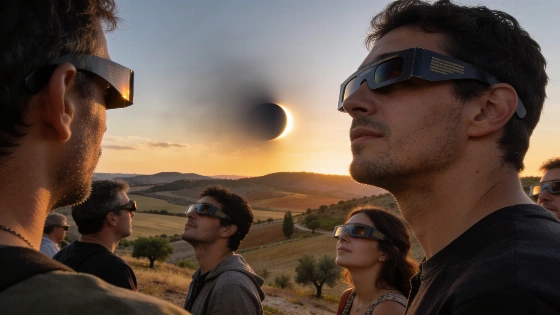
Safety remains a priority. Viewing the eclipse without proper eye protection can cause retinal burns, often without immediate pain but with lasting vision problems. Standard sunglasses, CDs, or X-rays are not safe substitutes for certified eclipse glasses. Only during the brief phase of totality is it safe to look at the Sun directly; at all other times, protective eyewear is essential, even when photographing the event.
The appearance of the solar corona during totality will depend on the Sun’s activity cycle, which is currently near its peak. This means the corona is expected to be more extensive and structured, with elongated features and irregularities. While modern instruments like coronagraphs have reduced the scientific necessity of eclipses, the event still offers opportunities for public engagement and small-scale experiments. The Observatorio Astronómico Nacional plans to focus on observation and outreach rather than scientific measurement.
For those planning to witness the eclipse, experts recommend traveling to the path of totality and choosing a location with an unobstructed view to the west, as the eclipse will occur close to 20:30 with the Sun low on the horizon. The experience is expected to draw significant attention, and local authorities are already considering crowd management and safety measures. In fact, concerns over public safety have previously led some municipalities to adjust their eclipse event plans, as seen when several Madrid towns cancelled public gatherings due to wildfire risks—details covered in this earlier report on local eclipse preparations.
Contextually, total solar eclipses are among the rarest astronomical events visible from any given location. The next opportunity for Spain to witness such a phenomenon may not arise for decades. The 2026 eclipse is expected to boost tourism in the affected regions, with hotels and local businesses preparing for an influx of visitors. Authorities and scientific institutions are emphasizing the importance of public education on safe viewing practices, as well as the unique scientific and cultural value of the event. For many in Spain, this eclipse represents a once-in-a-lifetime chance to observe one of nature’s most dramatic spectacles under optimal conditions.