Felipe VI called for joint protection of the EU's external borders during his visit to Helsinki. Finland backed Spain over Ceuta and linked security in the south with defence in the Arctic.
On 8 July, Prime Minister Pedro Sánchez said Spain would join NATO's forward land-forces mission in Finland to help protect the Arctic region. That decision gave Felipe VI's visit a clear defence role.
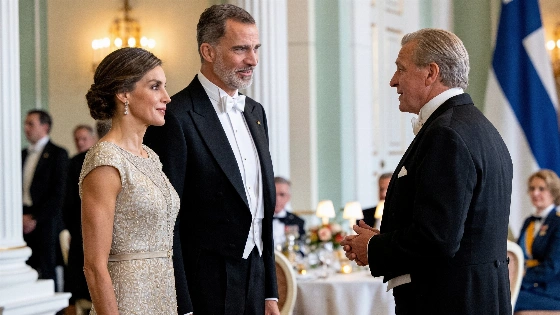
The king used a state dinner in Helsinki to call for shared protection of Europe's external borders. He said the EU's frontier is one and the same for all European citizens. His remarks came as Finland expressed solidarity with Spain over the mass irregular entry of migrants into Ceuta last July.
Felipe VI did not name the episode directly. Its relevance was clear. He said pressure on one member state affects all the others. Protecting an EU border, he argued, is more than a national security matter. It also tests Europe's credibility and its future as a political project.
On 8 July, Prime Minister Pedro Sánchez announced that Spain would join NATO’s forward land-forces mission in Finland to help protect the Arctic region, giving the royal visit a concrete defence dimension.
Finland's president Alexander Stubb spoke more plainly. He said security on the continent's southern border matters as much as security in the Arctic. No member state, he added, should face pressure that concerns Europeans as a whole.
Stubb described the Ceuta episode as a period of immense pressure for Spain. He compared its lessons with migration reaching Finland from Russia. The comparison did not erase the differences between the two situations.
The link was political. Both cases raise the tension between humanitarian duties and national and European security. Helsinki's concern is tied to its 1,300-kilometre border with Russia. Madrid's immediate concern was Ceuta and the EU's external frontier in North Africa.
That is why the visit mattered.
The 5–7 October programme in Helsinki and Rovaniemi was designed to address the full range of Europe’s external borders, from the Arctic to the Mediterranean. A seminar in Rovaniemi focused on security and cooperation at European borders and on the EU’s capacity to act internationally.
Spain and Finland are partners in the European Union and NATO. Both manage an external EU border. Felipe VI also pointed to Finland's position at a geopolitical crossroads and its history as a source of lessons Europe should not forget. He welcomed Finland's recent NATO accession and called the alliance an indispensable frame of reference.
Madrid's Foreign Ministry described the trip as part of a 360-degree defence policy. The approach linked European strategic autonomy with security in every direction, including the Arctic and Baltic regions.
The talks came during a period of tension around Europe's eastern and northern flanks. Before the visit, reports described drone incidents and other acts of sabotage linked to growing Russian pressure in the region.
Spain's institutions are also dealing with pressure on other fronts. An earlier report examined a dispute over housing policy and small landlords. In Helsinki, the focus stayed international: border security, alliance commitments and the need to stop responsibility from falling on individual states.
Before the dinner, Felipe VI and Letizia visited Helsinki City Hall. They had lunch with mayor Daniel Sazonov, and the king received the capital's medal of honour. He later met Parliament president Jussi Halla-aho and held talks with Prime Minister Petteri Orpo alongside Spain's Foreign Minister José Manuel Albares.
The trip continues on Wednesday in Rovaniemi, in Finnish Lapland. The king will visit the base of NATO's Land Forces Mission responsible for protecting the Arctic. Spanish soldiers serve there.
The programme also included meetings with Finnish and NATO units in Lapland, according to EFE. The visit therefore moved beyond political support and into practical defence cooperation.
Finland's security was also presented as part of Europe's wider defence. The country has an approximately 1,340-kilometre land border with Russia, one of the longest such frontiers in the European Union. That figure places Helsinki's concerns within the debate over NATO's northern and eastern flanks, rather than treating them as a purely national issue.
Felipe VI's message reached beyond the Ceuta episode. He placed every external EU border under a shared responsibility. Spain's migration pressure and Finland's Arctic and Russian-border concerns entered the same political frame.
Madrid won public backing from Helsinki. Finland also used the visit to say that southern and northern security cannot be handled as separate European problems.