Navantia has achieved a major breakthrough by laying the keel of the F-113 Menéndez de Avilés seven months ahead of schedule, while Germany’s F-126 program collapses under soaring costs. Spain’s advances in frigates and submarines are reshaping Europe’s naval landscape.
On July 20, Navantia marked a significant achievement by completing the keel laying of the F-113 Menéndez de Avilés in Ferrol, seven months ahead of the contractual deadline. This early milestone stands in sharp contrast to Germany’s troubled F-126 frigate program, which was abandoned after costs ballooned from €10 billion to over €18 billion and years of delays undermined confidence in the project.
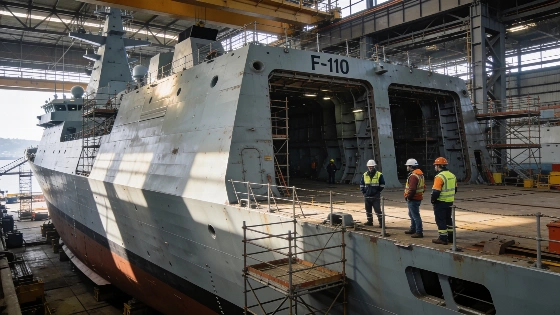
The F-113 is part of Spain’s ambitious F-110 frigate series, with four other vessels under simultaneous construction. The F-111 Bonifaz is already afloat at Ferrol’s dock 10, receiving its main systems before sea trials. The F-112 Roger de Lauria has completed its main structure and is preparing for launch after summer 2026, while the F-114 Luis de Córdova remains in early stages. The 2019 contract covers five ships for €4.325 billion, supporting nearly 9,000 jobs and involving around 500 Spanish companies. Navantia’s new Digital Block Factory, a €110 million investment, is now operational, aiming to modernize production and cut lead times.
Spain’s progress is not without its own challenges. While the F-113 milestone is ahead of schedule, the overall F-110 program has seen its timeline shift. The first F-110 was initially slated for delivery in 2026, but the current schedule places the F-111 Bonifaz’s handover in 2028. The Ministry of Defence has identified the delivery of the SPY-7 radar as a critical path issue for the program.
Submarine S-82 Enters Sea Trials
In Cartagena, the S-82 Narciso Monturiol, the second in Spain’s S-80 submarine series, began its first surface navigation tests on June 25. These sea trials will continue with dives and system checks at various depths, with delivery expected before the end of 2026. The S-81 Isaac Peral was handed over to the Navy in November 2023, and the S-83 Cosme García will be the first to feature Spain’s indigenous AIP (air-independent propulsion) system from the outset.
The S-80 program has faced its own setbacks. A critical weight issue discovered late in development forced a halt in production, a redesign, and lengthening of the submarine, with support from the Spanish Navy, the US Navy, and General Dynamics Electric Boat. While the program’s recovery demonstrates Spain’s ability to address major technical challenges, it also highlights the complexity and risk inherent in advanced naval projects.
Germany’s F-126 Collapse
Germany’s decision to cancel the F-126 program after spending nearly €2.3 billion underscores the volatility of large-scale naval procurement. The Ministry of Defence opted to replace the six planned F-126 frigates with eight MEKO A-200 vessels from TKMS, budgeting €6.3 billion for the first four and €5.3 billion for the next four. The first MEKO A-200 is scheduled for delivery in December 2029, but the sunk costs of the F-126 remain. Defence Minister Boris Pistorius has acknowledged the slim prospects of recovering damages from the main contractor, Damen.
France and Sweden Adjust Schedules
Elsewhere in Europe, France’s Naval Group delivered its first FDI frigate, Amiral Ronarc’h, in October 2025, and the first Greek unit in December. However, subsequent French deliveries have been pushed to 2027, 2029, 2031, and 2032. Sweden, meanwhile, has opened talks with France for four FDI-based frigates, with deliveries planned between 2030 and 2034. Navantia’s ALFA 4000 proposal was considered, but Sweden favored the French offer due to its maturity and production status. These shifting schedules illustrate the broader challenges facing Europe’s naval industry.
Spain’s recent advances in naval construction come at a time when the country is also investing in specialized defense talent and modernizing its shipyards. The ability to deliver complex vessels on or ahead of schedule could strengthen Navantia’s commercial position in future international tenders. As the European defense landscape evolves, Spain’s momentum in shipbuilding stands out, much like the precision and expertise seen in other sectors, such as the remarkable work of Spain’s Canadair pilots battling wildfires.