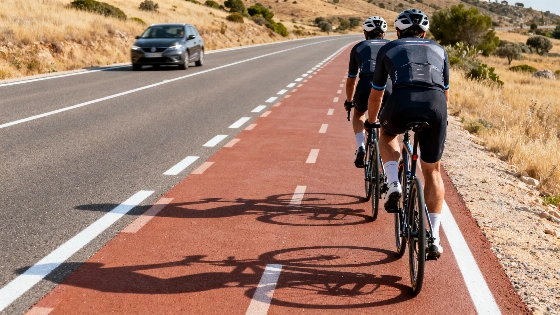
Spain’s government has approved sweeping changes to road safety rules. Drivers must slow down more when overtaking cyclists. New helmet and distance requirements will affect both urban and rural roads.
Spain’s Council of Ministers has enacted a major overhaul of the Reglamento General de Circulación, introducing stricter requirements for both drivers and cyclists. The reform, set to take effect from October 2026, aims to address the persistent risks faced by cyclists, pedestrians, and other vulnerable road users across the country.
One of the most significant changes targets overtaking on interurban roads. From the implementation date, any driver passing a cyclist will be required to reduce their speed by at least 20 km/h below the posted limit. For example, on a road limited to 90 km/h, overtaking must not exceed 70 km/h. This new rule builds on the 2022 traffic law, which already mandates a minimum lateral distance of 1.5 meters and imposes fines of up to 200 euros and a six-point license deduction for dangerous overtaking. Additionally, on roads with more than one lane in each direction, drivers will now be obliged to fully change lanes when overtaking cyclists.
Urban traffic will also see notable adjustments. Drivers following a cyclist in the same lane must maintain a minimum distance of five meters, a measure designed to reduce pressure and risk, particularly in narrow or congested streets. The reform also clarifies the position of cyclists in city traffic, granting them priority to ride in the center of the lane to enhance visibility and discourage unsafe overtaking. Municipalities will have the authority to allow two-way cycling on single-lane streets with speed limits of 30 km/h or less, aligning Spanish practice with common approaches in other European cities.
Helmet regulations are set to become more stringent. All exceptions for helmet use on interurban roads are eliminated, meaning every cyclist must wear a helmet at all times outside urban areas, regardless of circumstances. Previous exemptions, such as for long climbs or medical reasons, will no longer apply. The rules for professional bicycle couriers are also tightening: from October, they must wear both a helmet and a reflective vest while working, with violations classified as serious offenses and subject to 200-euro fines.
The Dirección General de Tráfico (DGT) expects these measures to reduce accident rates among cyclists, a group that remains particularly exposed on Spanish roads. The reform package also introduces updates for motorcyclists and users of electric scooters, reflecting a broader push to adapt road safety standards to evolving mobility trends. The changes are part of a wider effort to redefine how different types of road users share public space, especially as cities and regions continue to adapt their transport policies. In the context of ongoing debates about urban mobility and safety, these new rules follow a series of local initiatives, such as the recent launch of new political platforms in Madrid focused on city-level reforms—an example being the emergence of Independientes por Madrid, as reported in coverage of local political shifts.
Spain’s approach to road safety has evolved in recent years, with authorities responding to rising numbers of cyclists and the growing popularity of personal mobility vehicles. According to the DGT, the number of registered bicycles and electric scooters has increased steadily, prompting calls for clearer rules and better protection. The new regulations are expected to have a direct impact on daily commutes, delivery services, and recreational cycling, as well as on the responsibilities of drivers in both urban and rural settings. The reform underscores the government’s commitment to reducing traffic-related injuries and fatalities, while also aligning Spanish standards more closely with those of other European countries. As the changes come into force, both drivers and cyclists will need to adapt their habits to comply with the updated legal framework and avoid significant penalties.