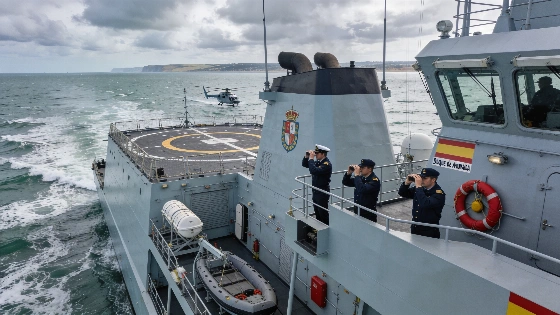
Frontex has sent Spanish patrol vessels Duque de Ahumada and Río Segura to the English Channel for a high-stakes rescue operation. Their mission is strictly limited to saving lives, not intercepting boats, as Europe faces mounting pressure over migrant crossings.
The Spanish patrol ship Duque de Ahumada is now working in the English Channel, the first time Frontex has sent a Spanish vessel to support French-led rescue efforts in these waters. The mission, which began in early September 2026, is focused on saving people already in danger at sea, not stopping boats. Frontex officials describe this as part of a broader European response to the ongoing migration crisis in the Channel, with a clear emphasis on the operation's humanitarian purpose.
This deployment is different from earlier missions. The Duque de Ahumada and, later this month, the Río Segura, are assigned strictly to search and rescue—no maritime interceptions or detentions. French authorities remain in charge, with the CROSS Gris-Nez center coordinating all actions. The Spanish ships are part of a multinational effort that includes France, Belgium, the Netherlands, and Frontex, along with European maritime safety and fisheries agencies. According to Reuters and Frontex, the ships will rotate: Duque de Ahumada is on duty in early September, Río Segura will take over at the end of the month, and a Lithuanian vessel is expected to join from November through January 2027.
The Duque de Ahumada can remain at sea for up to 30 days and accommodate at least 100 rescued people, making it one of the most capable assets in the Guardia Civil fleet.
Spain has formally asked to keep the Duque de Ahumada in national waters for 2027, citing the need for more support around Ceuta. That request, sent to Brussels in late August, is still under review. The current Channel deployment, set for September and October, does not mean Spain's proposal has been rejected, but shows the temporary and rotating nature of Frontex's naval reinforcements. Lithuanian vessels are scheduled to take over from November through January 2027. Spanish media report that the request is mainly tied to border security concerns near Ceuta, and the European Commission has said it is ready to strengthen Frontex presence at the EU's external borders if needed.
The Duque de Ahumada, delivered to the Guardia Civil in September 2025 and built by Astilleros Armón, is 82 meters long and 14 meters wide. It can stay at sea for up to 30 days without returning to port. Onboard, there is a hospital area, medical bay, and space for at least 100 rescued people. The ship also has a helipad, two rapid intervention boats, and a remotely operated underwater vehicle for deep-sea inspections. These features reflect a €35 million investment in maritime capability, confirmed by Spanish and European defense sources.
In practice, the Spanish ships will detect and verify small migrant vessels, passing real-time information to French authorities. This intelligence is combined with aerial surveillance from Frontex, which has kept a patrol plane over the Channel since 2021. The focus is on quick response to fragile boats and dangerous weather, not on policing migration routes. All maritime actions are coordinated by the French CROSS Gris-Nez center, under the authority of the maritime prefecture for the Channel and North Sea, according to French and European sources.
The Channel operation is part of a wider European rotation of Frontex maritime resources, with two Spanish ships deployed from September to October, followed by a Lithuanian vessel until January 2027. This approach allows for flexible reinforcement of search and rescue capabilities in response to evolving migration patterns.
Reuters
For Spain, this deployment is both a show of European cooperation and a reminder of the limits on national control when Brussels and Paris set the agenda. As Frontex rotates its resources and the Channel remains a hotspot for migrant crossings, Madrid's influence in future talks will depend on its willingness to work within joint European operations. The real challenge will come if Spain's own border needs conflict with the priorities of its EU partners.