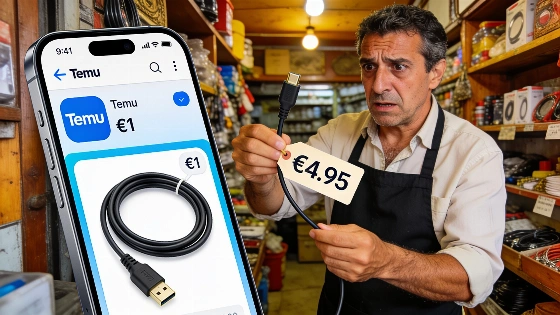
A Spanish bazaar owner has raised concerns after discovering that Temu sells cables for as little as €1, far below his own retail price of €4.95 and even under his supplier’s cost. The case highlights the mounting pressure small shops face as global e-commerce platforms reshape local retail dynamics.
When a Spanish bazaar owner compared his €4.95 cable to the same item selling for just €1 on Temu, the price gap was impossible to ignore. Featured in a late 2024 episode of Equipo de Investigación, the shopkeeper revealed that the online platform’s prices were not only lower than his own, but even undercut what he paid his supplier. “We sell it for €4.95. On Temu, it’s €1 or €1.50,” he told the cameras, holding up the product in question.
The difference—between €3.45 and €3.95 per item—translates to a staggering 70–80% discount compared to his shelf price. For many local retailers, such margins are unthinkable. The shopkeeper argued that Temu’s aggressive pricing was drawing customers away, making it increasingly difficult for traditional stores to compete.
Online Bargains, Offline Struggles
According to the report, the bazaar owner’s experience is not unique. He noted that Temu and similar platforms routinely offer products below the wholesale rates available to small businesses. While the exact cost he paid for the cable was not disclosed, the implication was clear: the economics of local retail are being upended by global e-commerce giants.
Seeking to adapt, some shops have turned to new sales models, such as selling “surprise packages” sourced from returns to Amazon, Shein, or Temu—bundles that are resold at discounted rates. This trend reflects a broader shift in consumer behavior, as shoppers increasingly hunt for bargains online and offline.
Shops Become Pickup Points
The digital transformation is also changing how physical stores operate. The Equipo de Investigación segment showed how Shein and Temu now use neighborhood businesses—including herbalists, real estate agencies, and bazaars—as pickup points for online orders. The bazaar owner described how, within just a few weeks, his shop went from handling one or two packages a day to receiving up to 20 daily, plus another ten for outgoing deliveries. The surge in parcel traffic far exceeded his initial expectations.
While this new role brought in some extra income, the owner admitted it did little to offset the decline in his core retail sales. The compensation for handling packages, he said, could not make up for the loss of customers lured by lower online prices. He also pointed out that the exact payment per package and the scale of his revenue drop were not specified in the report.
Margins Squeezed by Supply Chains
Asked about the reasons behind the price gap, the shopkeeper explained that his supplier acts as an intermediary, not a direct manufacturer. “My supplier is an intermediary, not a direct producer. They also pay taxes and wages,” he said, highlighting the extra costs that local businesses face before a product even reaches the shelf. In contrast, platforms like Temu can source directly from factories, bypassing several layers of markup.
Still, the report cautioned that this testimony reflects one retailer’s experience and does not prove that all products on Temu or Shein are always cheaper than those in local shops. The example, however, illustrates the mounting challenges for small businesses as digital platforms reshape the retail landscape.
Context and Wider Impact
The pressure on traditional retailers is not limited to electronics or cables. As noted in a related story about the hidden value of copper in home renovations, even seemingly mundane items can become battlegrounds for price and profit as market dynamics shift (see how a Madrid plumber turned scrap copper into unexpected earnings). For many Spanish shop owners, the rise of e-commerce is forcing a rethink of business models, supply chains, and the very role of the neighborhood store.
While some adapt by embracing new services or digital tools, others struggle to keep pace with rapid change. The story of the bazaar owner underscores a broader reality: as online platforms continue to expand, the future of small local shops in Spain may depend on their ability to innovate—or risk being priced out of the market altogether.