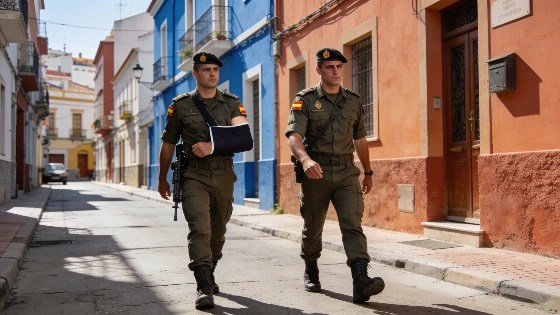
A wave of violent assaults has left Spanish soldiers in Ceuta injured and hospitalised. The Ministry of Defence confirms several cases, prompting a shift to individual armament for all patrols as security concerns mount.
Spanish soldiers stationed in Ceuta are now required to patrol with individual weapons after a series of violent attacks left several injured and in hospital. The Ministry of Defence confirmed that those hurt were taken to the Hospital Central de la Defensa Gómez Ulla, with injuries including knee sprains and a fractured fibula. At least two soldiers remain hospitalised, and one has undergone surgery, according to official statements reported by Spanish media.
The change in patrol policy follows growing concern from the Asociación de Tropa y Marinería Española (ATME). Its president, Marco Antonio Gómez, has warned publicly that attacks are becoming more frequent and severe. He says the perpetrators—identified as undocumented migrants—act with a sense of impunity, seeing the lack of immediate consequences as encouragement for further violence. The most recent serious assault happened in the Juan XXIII area on the night of September 12, when a soldier suffered a fractured fibula and shoulder injuries after falling onto rocks during an attack.
At least nine attacks on soldiers in Ceuta have been documented since late August, involving stones, bladed weapons, and corrosive liquids.
Gómez says the escalation has forced a change in patrol rules. Previously, only one member of each patrol was allowed to carry a weapon, a measure introduced after earlier border incidents. Now, every soldier on patrol is authorised to be armed, reflecting the increased risk and need for quick self-defence. This change has been confirmed by several independent publications citing defence ministry sources.
Security officials report that some attackers have set traps to avoid being identified or arrested, making it harder to maintain order. Despite the seriousness of the situation, Gómez points out that there are still no clear instructions for soldiers under attack, leaving each to decide how to respond. This lack of a unified protocol exposes personnel to both physical danger and legal uncertainty. The ATME has called for military personnel to be recognised as law enforcement agents and for their profession to be officially classified as high-risk, citing the rising number and severity of assaults.
Some suspects have been detained, but others remain at large. The Ministry has not issued specific warnings about a possible new mass crossing, though patrols have been increased. Gómez notes that the government is keeping sensitive information tightly controlled, with no official confirmation of any imminent large-scale incident.
The political context around these incidents has intensified, with the Sumar party publicly calling for an investigation into allegations of possible abuses by military personnel against migrants in Ceuta. This reflects a parallel debate over the conduct of both sides and highlights institutional tensions between the military, the defence ministry, and political actors.
Ceuta's current security situation is being exploited by some groups of undocumented migrants, who have reportedly organised and coordinated attacks and ambushes against both the military and state security forces. The pattern of violence has sparked urgent debate within defence circles about whether current measures are adequate and about the risks faced by personnel. Several independent reports describe the situation as a series of incidents over several weeks, with repeated injuries among soldiers and a gradual tightening of security measures.
Recent changes in Spanish security policy are not limited to Ceuta. For example, leadership disputes have also affected law enforcement elsewhere, as seen in the recent resignation of the Catalan police chief after a leadership clash.
The situation in Ceuta highlights a serious challenge for Spain's border management and internal security. The decision to arm all patrolling soldiers individually marks a clear shift from previous practice and shows how seriously authorities now view the threat. As attacks become more organised and perpetrators test the limits of enforcement, the lack of clear operational guidance for soldiers remains a major vulnerability. The government's cautious communication and gradual policy changes suggest a reactive approach, leaving frontline personnel to manage a volatile environment with limited support. Without decisive action and clear rules of engagement, the risk to both military and civilian safety in Ceuta is likely to remain high.