The Supreme Court maintains that amnesty does not cover malversación, stalling the release of key Catalan leaders. The Constitutional Court is not expected to rule soon. The EU court’s decision removes one barrier, but legal uncertainty remains.
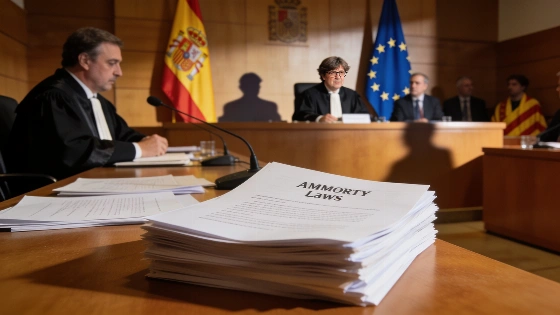
The path to amnesty for Catalan independence leaders remains blocked, despite a significant ruling from the Tribunal de Justicia de la Unión Europea (TJUE). While the European court confirmed that Spain’s amnesty law does not violate EU principles or financial interests, the Supreme Court continues to interpret the law narrowly, insisting that malversación—embezzlement of public funds—remains excluded from amnesty. This stance means that the arrest warrant for Carles Puigdemont, former president of the Generalitat and leader of Junts, is unlikely to be lifted in the near future.
The Constitutional Court, meanwhile, has yet to resolve the appeals filed by the leaders of the 2017 independence attempt. Its decisions are not expected before the end of the summer recess, prolonging uncertainty for figures such as Puigdemont, Oriol Junqueras, Raül Romeva, Jordi Turull, and Dolors Bassa. The Supreme Court’s Penal Chamber argues that the amnesty law itself explicitly excludes malversación if it led to personal enrichment, a position it shows no sign of revising even after the TJUE’s clear statements.
The TJUE clarified that the amnesty law does not threaten the EU’s financial interests, nor does it breach essential European legal principles or anti-terrorism directives. However, the Supreme Court maintains that the real issue is the alleged enrichment of the ‘procés’ leaders, who, according to the court, did not personally cover the costs of the independence campaign. This interpretation keeps the legal process stalled, even as the European court’s decision removes a major obstacle. The Tribunal de Cuentas and the Audiencia Nacional, both of which challenged the law, may find the TJUE’s position relevant, but the Supreme Court’s resistance remains the main barrier.
There is, however, a possibility that the Penal Chamber could soon resolve pending appeals related to public disorder charges, as the TJUE has indicated these do not fall under anti-terrorism rules. The real challenge now lies with the Constitutional Court, where a progressive majority and favorable reports from the Fiscalía and the State Attorney’s Office suggest a more expansive reading of the amnesty. If the court eventually rules that the Supreme Court violated the fundamental rights of the independence leaders by denying them amnesty, it could mark a turning point—but this process is expected to take time. The first appeal is being handled by magistrate José María Macías, who opposes the current amnesty law, and his draft ruling may be rejected, requiring a new rapporteur.
For now, the most immediate effect is the green light from European justice for the amnesty law as a tool for reconciliation. The TJUE, echoing the opinion of its Advocate General, rejects the idea that the law is a self-serving political maneuver, instead recognizing its aim to reduce institutional and political tensions. Where some see a concession to separatists to secure Pedro Sánchez’s investiture, the European court sees a broader purpose serving the general interest. This legal tug-of-war continues to shape the political landscape, as highlighted in recent developments where Catalan leaders have pressed for immediate enforcement of the amnesty following the EU court’s endorsement—an issue explored in more detail in this related report.
Contextually, the debate over the amnesty law reflects deeper divisions within Spain’s judiciary and political system. The Supreme Court’s insistence on excluding malversación underscores ongoing tensions between national courts and European institutions. The Constitutional Court’s eventual decision could have far-reaching implications for the legal status of Catalan politicians and the broader reconciliation process in Spain. As the legal process unfolds, the practical impact on those involved—and on Spanish politics—remains uncertain, with the timeline for resolution still unclear.