In early 1973, more than 100,000 public school teachers staged a strike that shook Franco’s Spain. The protest exposed deep-rooted discontent and marked a pivotal moment for the country’s education sector.
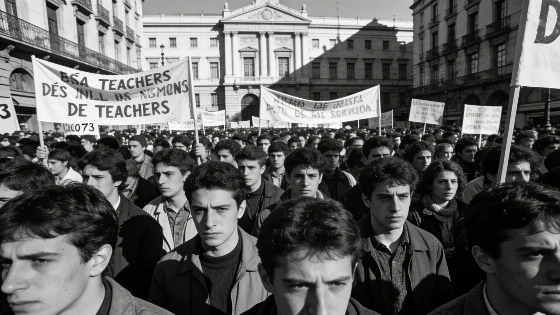
In the opening months of 1973, Spain witnessed a mass teachers’ strike that directly confronted the Franco dictatorship. Over 100,000 public school educators, long subjected to poor working conditions and low pay, coordinated a nationwide walkout. The scale and determination of this action unsettled the regime, revealing the extent of dissatisfaction among those responsible for educating the nation’s youth.
The phrase “Eres más pobre que un maestro de escuela” had become a common saying, reflecting the chronic financial hardship faced by teachers throughout much of the twentieth century. Under Franco’s rule, these difficulties intensified, with public educators experiencing particularly harsh treatment. By early 1973, frustration had reached a breaking point, leading to a coordinated strike that would become a landmark in Spain’s labor history.
The protest, which unfolded between January and February, was unprecedented in its scope. Teachers from across the country joined forces, demanding better salaries and improved working conditions. Their collective action not only disrupted the functioning of schools but also sent a clear message to the authorities about the urgent need for reform. The strike’s impact was felt far beyond the education sector, as it exposed cracks in the regime’s control and inspired further mobilization among other professional groups.
Although the dictatorship attempted to suppress the movement, the teachers’ strike left a lasting legacy. It planted the seeds for the development of independent unions within the education sector, setting a precedent for future labor activism. The echoes of this historic protest can still be heard in more recent demonstrations, such as those that took place in Valencia last month, where educators once again voiced their demands for fair treatment and recognition.
Spain’s experience with mass protest is not limited to the education sector. Public demonstrations have often served as a catalyst for broader social change, as seen in other contexts. For example, the disruption of a minute of silence for Venezuela’s earthquake victims during a Spain-Uruguay football match in Mexico sparked widespread debate and criticism, highlighting how collective action and public response can shape national conversations. Details of that incident can be found in this report on the controversy at the Guadalajara stadium.
The 1973 teachers’ strike stands as a pivotal episode in Spain’s transition from dictatorship to democracy. It demonstrated the power of organized labor to challenge entrenched authority and contributed to the eventual emergence of a more open and participatory society. Today, the legacy of those educators continues to influence debates about workers’ rights, public education, and the role of collective action in shaping Spain’s future.
For context, Spain’s education system during the Franco era was tightly controlled by the state, with limited space for independent organization or dissent. The 1973 strike marked one of the first large-scale challenges to this system, preceding the broader wave of labor and social movements that would gain momentum after Franco’s death in 1975. The event is now recognized as a turning point that helped lay the groundwork for the modern Spanish labor movement and the democratization of public institutions.