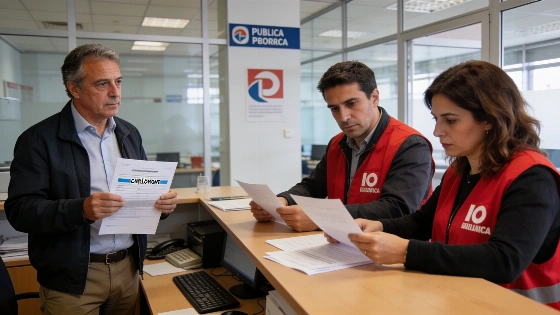
The main union at Telemadrid has reported the hiring of the director general’s driver. The employee was added to the public broadcaster’s staff while a private contract was still active. The process is now under investigation.
The hiring of the director general’s driver at Telemadrid has triggered a formal complaint from the company’s works council, which alleges that the recruitment process bypassed established procedures and legal safeguards. The controversy centers on the driver’s transition from a private contractor to a direct employee of Radio Televisión Madrid (RTVM) on July 15, despite an existing four-year contract with Auto Lavapiés for chauffeured vehicle services that was still in force.
According to the complaint filed by the CC OO union, which represents the majority of staff, the driver had previously performed the same duties as an employee of Auto Lavapiés, the company awarded the public contract. The union questions both the method of hiring and the decision to exclude the new position from the broadcaster’s collective agreement, arguing that such a move lacks legal basis and transparency.
Telemadrid management maintains that the recruitment was carried out in full compliance with labor regulations and insists that the hiring of the driver and the vehicle contract are unrelated processes. They also note that the corporation’s legal department has not yet received the union’s complaint, and that any new job category would require joint agreement between management and the works council.
Union representatives requested detailed information from Human Resources about the contract type, job classification, working hours, selection process, and criteria used to select the candidate. They also asked whether any internal or external job posting had been published to ensure principles of equality, merit, and transparency. The company confirmed the hiring date and contract type, and stated that the driver was excluded from the collective agreement, but did not provide details on the selection process.
The union later learned that the hiring was described as temporary, pending a definitive selection process. However, they claim there is no evidence of such a process, nor any public or internal announcement, selection criteria, or evaluation basis that would clarify how the appointment was made. The works council argues that the driver’s role does not qualify as a management position and should therefore fall under the collective agreement, as stipulated by Article 34 of Law 8/2015 governing Radio Televisión Madrid.
Another point of contention is the creation of the new position. The union asserts that there is no record of prior approval by the company’s governing bodies or submission to the Board of Directors, raising further doubts about the legality and transparency of the process. The complaint asks labor inspectors to review the full hiring file, documentation on the selection process, justification for the contract type, reasons for excluding the position from the collective agreement, and whether the job was included in the official staff list and properly authorized.
Adding to the irregularities, the union notes that the employment contract was signed directly by the director general, José Antonio Sánchez, rather than the usual signatory, the head of Human Resources. While this alone does not constitute a violation, the works council believes it should be examined as part of the overall investigation.
This case highlights ongoing concerns about hiring practices in Spanish public institutions. Similar controversies have surfaced elsewhere, such as the recent scrutiny over urgent staff appointments in local administrations, as seen when the PSC called for an independent audit after the mayor of Ripoll’s daughter was hired as a police officer. These incidents underscore the importance of transparent recruitment and adherence to legal standards in the public sector.
In Spain, public sector hiring is governed by strict rules to ensure fairness, merit, and equal opportunity. Any deviation from these principles can lead to legal challenges and reputational damage for the institutions involved. The outcome of the labor inspection at Telemadrid may set a precedent for how similar cases are handled in the future, especially regarding the boundaries between direct appointments and competitive selection processes in public companies.