Tesla faces two major safety campaigns in China covering 5,716,552 vehicles in total. Announced by the State Administration for Market Regulation (SAMR) on 21 August 2026, the campaigns address separate risks: the visibility and operation of emergency door releases, and driver-attention monitoring when assisted-driving features are active. The affected vehicles include China-built Model 3 and Model Y cars, along with imported Model 3, Model X, and Model S units.
The emergency door-release recall covers 2,975,910 vehicles, including 973,156 domestically produced Model 3s and 1,956,713 Model Ys, as well as imported vehicles. SAMR said the interior mechanical emergency handles could be difficult to identify and operate because their color closely matches the surrounding trim. In a severe crash that disables the low-voltage system, occupants could struggle to escape, complicating rescue efforts. The campaign was scheduled to begin on 25 September 2026.
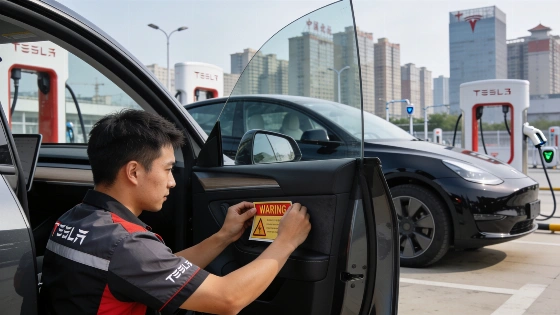
Tesla’s remedy combines physical labels with software changes. Vehicles without the required markings are to receive warning labels free of charge; those that already have them will not need the physical fix. An over-the-air (OTA) update is also intended to lower the windows automatically after a crash, helping occupants find and use an exit if the low-voltage system is impaired. SAMR said the issue could delay occupants’ escape and make rescue harder for people outside the vehicle.
The second campaign covers 2,740,642 China-built Model 3 and Model Y vehicles and was described as taking effect immediately. SAMR’s concern was that the existing system did not adequately alert drivers when they looked away from the road while assisted steering or combined driver-assistance functions were active. Tesla plans to offer a free OTA update that adds cabin-camera monitoring of driver attention and related alerts to existing steering-torque monitoring.
The two Tesla campaigns are part of a broader Chinese recall wave involving hidden or electrically operated door handles. China News Agency reported that Tesla’s door-related campaign was the largest in that group, accounting for about 69% of recalls tied to the issue. The concern shows how a design feature used across a growing number of electric vehicles can create a rescue-access risk when electronic systems or a vehicle’s low-voltage supply fail.
The campaigns also fall within a wider regulatory focus on connected and intelligent vehicles. China News Agency reported that SAMR counted 20.3938 million intelligent connected vehicles recalled in the first nine months of 2026 across 617 recall actions. More than 70% were reportedly prompted by regulatory investigation or supervision. At the World Intelligent Connected Vehicle Congress in Beijing, Chinese officials warned manufacturers to meet accident-reporting and defect-recall obligations. They also said products without sufficient validation must not be rushed onto the road.
Software remedies are attracting regulatory scrutiny, too. China’s Ministry of Industry and Information Technology opened public consultation on draft changes to vehicle market-access rules that would require automakers to file before deploying OTA updates. The proposal brings software safety interventions under the vehicle-regulation structure instead of treating them solely as routine product updates.
As elespanol motor noted, the recalls show the growing scrutiny of electric-vehicle safety in China, the world’s largest EV market. Their scale highlights the challenge of balancing advanced technology with practical needs for occupant escape and driver supervision. Similar questions apply in Europe, where new models face developing standards. Recent hybrid SUV launches also show how the sector is changing, including the JAECOO 7 SHS Plug-In Hybrid.
For Tesla owners in China, the campaigns mean software changes and, where needed, physical labels. They address different risks and cover separate groups of vehicles, with the door-release campaign scheduled to begin after the driver-monitoring action took effect. Regulators and consumers will watch Tesla’s response as China continues to scrutinize safety in increasingly software-dependent vehicles.