30 new unmarked police motorcycles appear in Spain: where and how bikers are now fined. The Guardia Civil has deployed 30 new unmarked motorcycles on the roads. They operate in high-accident regions and on popular motorcyclist routes. Now, violators will be stopped and fined on the spot.
Thirty new unmarked motorcycles have appeared on Spanish roads—a move by the Civil Guard aimed at tackling dangerous violations among motorcyclists. The new patrols are already operating in regions where motorcycle traffic is particularly intense and accidents are frequent.
Motorcycles in different colors, so as not to stand out in the traffic flow, patrol routes with the highest concentration of motorcyclists. This primarily concerns Andalusia, Valencia, Galicia, Castile and León, the Balearic and Canary Islands. Special attention is paid to areas and times with the most alarming accident statistics—such as popular routes on weekends and holidays.
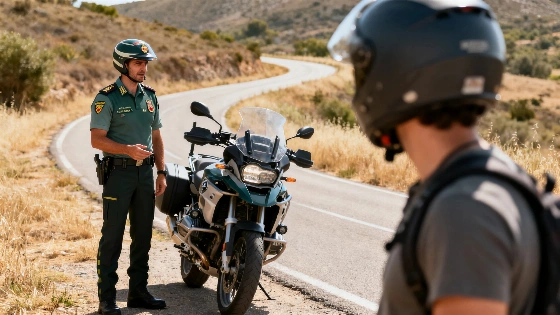
The main difference in the new scheme lies in how violations are detected and processed. Previously, agents in civilian clothes relayed information about an offender to the nearest patrol, which then stopped the driver. Now, things work differently. Civil Guard officers on trap motorcycles patrol in uniform and stop offenders themselves, issuing fines on the spot. This streamlines the process and reduces the chance that the driver will escape or change their behavior after a warning.
Attention is paid not only to speeding, but also to dangerous maneuvers—driving into oncoming lanes, riding with uncertified parts, and aggressive driving styles. According to Talent24h, the aim of the innovation is not only to increase the number of fines, but also to create a sense of constant monitoring among motorcyclists, in order to reduce the number of serious violations and accidents.
The introduction of trap motorcycles is part of a broader strategy to reduce road accidents. As Talent24h notes, similar measures have already proven effective in other European countries. In Spain, however, motorcycle safety remains a pressing issue: according to the DGT, this category of drivers most often becomes involved in serious traffic accidents.
It is important to remember that Spain's traffic regulations can be enforced quite strictly. For example, an officer can fine a driver even for driving barefoot if they decide it impedes control of the vehicle—more details on this can be found in the article about fines for driving without shoes.
Experts note that the appearance of new trap motorcycles is not so much an attempt to increase fine revenues as a step toward changing road behavior. In the coming months, it will become clear how much this measure will affect accident statistics and discipline among motorcyclists.