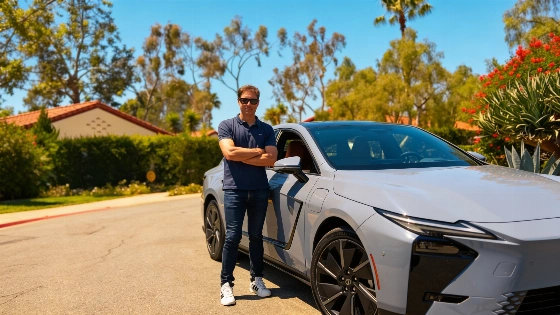
Lexus ES New Generation: Hybrid, Electric Motor, and Surprisingly Spacious. Lexus has unveiled the eighth-generation ES—a sedan offering both hybrid and fully electric powertrains, up to 343 hp, and a record-breaking amount of rear seat space. The model is already available in Europe starting at €61,500.
The eighth-generation Lexus ES enters the market with a noticeably updated exterior, new technologies, and a choice between a hybrid and a fully electric version. The 5.14-meter-long model targets those who appreciate comfort, quietness, and spaciousness in the cabin, but are not ready to give up the classic sedan shape even in the era of crossover dominance.
In Europe and the US, the Lexus ES has traditionally competed with the Audi A6 and BMW 5 Series, but now the Japanese sedan is banking on flexibility: buyers can choose between a 201 hp hybrid and two electric versions — 350e (224 hp) and 500e (343 hp). The electric model promises a range of up to 529 kilometers and improved charging times, while the drag coefficient has been reduced to 0.28, directly impacting efficiency and range.
Exterior and interior details
Visually, the new ES stands out with its elongated silhouette, striking grille, narrow headlights, and sharp body lines. The wheels can be up to 21 inches, and the nearly 5.14-meter length emphasizes the model’s status. The front row has been completely redesigned: it now features a classic steering wheel, a 12.3-inch digital instrument cluster, and a 14-inch central multimedia screen. For the first time in the brand's history, the Lexus Advanced multimedia system has been introduced, offering increased processing speed and 256 GB of memory. The traditional glove box for the front passenger has been retained— a rarity in modern cars.
Comfort and technology for rear passengers
One of the main features of the ES is its spacious rear seat. An almost three-meter wheelbase and smart layout provide impressive legroom and headroom. Lexus engineers emphasize that they paid special attention to the comfort of all passengers during development. The interior is remarkably quiet, with sound insulation allowing easy conversation between rows even at high speeds. All interior elements are intuitively placed, enhancing the sense of coziness and premium quality.
Dynamics and handling
The hybrid ES 300h combines a 2.5-liter gasoline engine with a compact lithium-ion battery, producing 201 hp and operating with an automatic transmission. The suspension is tuned to ensure a balance between ride smoothness and cornering stability. The new steering rack with electric power assist delivers more precise handling, and the updated suspension design minimizes body roll.
Prices and competitors
In Europe and Spain, demand is expected to focus on the hybrid version, but fully electric models are also available. The top-of-the-line 500e comes equipped with Total Direct4 all-wheel drive. The base price for both entry-level versions is €61,500. Main competitors include the Audi A6, BMW 5 Series, and Mercedes E-Class, but Lexus is betting on a combination of quietness, comfort, and technology.
Interestingly, the electric vehicle market in Spain continues to grow: recently, the Tesla Model Y became the country’s best-selling electric crossover, highlighting the increasing interest in electrification — you can read more about this in our article about the reasons for the popularity of the Tesla Model Y.
The eighth generation Lexus ES demonstrates that classic sedans can remain relevant if they offer modern technology, flexible powertrain options, and a high level of comfort for all passengers.