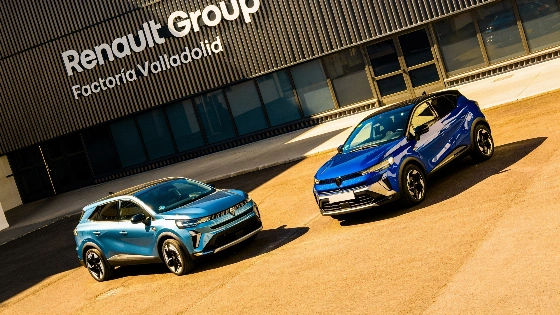
Renault launches production of five new electric cars in Spain. Renault has officially assigned its plants in Palencia and Valladolid to manufacture five new electric vehicles. This marks the brand's first large-scale production of electric models in Spain and represents a significant step forward for the industry's future.
Renault has announced the launch of production for five new electric vehicles at its plants in Palencia and Valladolid. This decision marks a milestone for the entire Spanish automotive industry: for the first time in the brand’s history, Spanish facilities will be responsible for the mass production of fully electric Renault models.
For Palencia, this means not just an expanded lineup, but a profound technological transformation. The plant will receive the latest RGEV Medium 2.0 platform, enabling the production of lighter, more modern, and energy-efficient vehicles with increased driving range. Investments in retooling and upgrading the production lines will turn Palencia into one of Renault’s key global centers for electromobility.
Valladolid also retains strategic importance: it has been entrusted with the production of new highly efficient models, ensuring steady workload and long-term prospects for the site. Together, both facilities form a powerful industrial cluster in Castile and León, capable of meeting the strictest environmental standards and the demands of the European market.
As noted by Renault Group management, the compromise reached with the unions was the result of complex negotiations, during which working conditions, production flexibility, and salary indexation were discussed. Thanks to the agreement, not only has Spain secured the production of new models, but jobs have also been maintained for more than 6,000 employees and thousands of suppliers.
The implementation of the RGEV Medium 2.0 platform is of particular importance: it gives Spanish engineers and workers access to the group's most advanced technologies. This not only strengthens Renault's position in Spain, but also raises the country's status as one of the leaders of the European electric vehicle industry.
In the context of growing competition in the electric vehicle market, Renault's decision is particularly significant. For example, earlier the Tesla Model Y became the best-selling electric model in Spain, highlighting the relevance of shifting to mass production of electric cars for European brands as well.
According to Renault Group, final approval of the agreement is expected after internal procedures and votes at the plants. After that, the factories in Palencia and Valladolid will officially become part of the brand's global electrification strategy, making Spain one of the key players in the electric vehicle market.