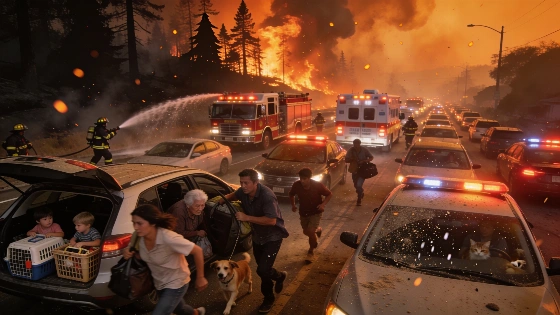
A fast-moving wildfire has triggered the evacuation of Chapinería and nearby towns in Madrid. Residents fled with little warning as smoke and ash filled the area. Authorities declared a national emergency and mobilized European firefighting support.
Emergency evacuations swept through Chapinería and neighboring towns in Madrid after a major wildfire, fueled by strong winds and high temperatures, advanced rapidly on Friday. Residents like Honorina Hernández were forced to leave their homes with minimal notice, taking only essential medication and pets as thick smoke and burning embers engulfed the area. The regional government ordered the evacuation of Chapinería, Navas del Rey, and Colmenar del Arroyo as the fire, which began as three separate blazes, merged into a single, uncontrollable front.
According to EL PAÍS, the situation escalated quickly, leaving little time for residents to prepare. Many, including Hernández, described the evacuation as chaotic and disorienting, with communication lines down and uncertainty about the fate of their homes. While some managed to escape by car to Brunete, others without vehicles were transported by a fleet of 24 buses to Villaviciosa de Odón, as authorities aimed to move at least 1,200 people in the first phase alone. The number of evacuees in the region reached 19,000 by midday.
Officials confirmed that over 6,000 hectares had already been consumed by the fire, which remained uncontained as of Friday. The Minister of the Interior, Fernando Grande-Marlaska, declared a national emergency for both the Community of Madrid and the province of Ávila, where another active blaze in Burgohondo threatened to cross into Madrid territory. The command center was established in Cenicientos, with Marlaska describing the day as extremely challenging due to wind speeds reaching 50 kilometers per hour and soaring temperatures. In response, Spain activated the European Union’s emergency mechanism, prompting the European Commission to dispatch four Canadair firefighting aircraft from Greece and Italy to reinforce local efforts.
Upon arrival in Brunete, many evacuees faced new difficulties, such as finding shelter for their pets and reuniting with family members amid the confusion. The town was overwhelmed with vehicles and displaced residents from multiple affected areas. Communication remained sporadic, with many only able to contact emergency services. Hernández noted that, despite the scale of the evacuation, authorities had not provided information on when residents might return home, adding to the prevailing sense of uncertainty.
Wildfires have become an increasingly severe threat in Spain, particularly during periods of extreme heat and drought. The rapid escalation of the Chapinería fire highlights the vulnerability of rural communities and the logistical challenges of large-scale evacuations. In recent years, emergency services have faced similar crises, such as the gas explosion and fire at the Plaça de Sants metro works in Barcelona, which also required swift action and coordination among local and national authorities. For more on how emergency responses unfold in Spain, see this report on the Barcelona metro fire incident.
Spain’s reliance on European firefighting resources underscores the cross-border nature of wildfire risks and the importance of coordinated response strategies. As climate patterns shift, the frequency and intensity of such incidents are expected to rise, placing additional pressure on emergency infrastructure and community preparedness. The events in Chapinería serve as a stark reminder of the speed at which disaster can strike and the critical need for effective evacuation planning and support for affected residents.