Nearly 3,000 students in Valencia are starting another year in makeshift classrooms. Unions and parents are demanding urgent action as negotiations with authorities stall, while climate risks and political disputes deepen the education crisis.
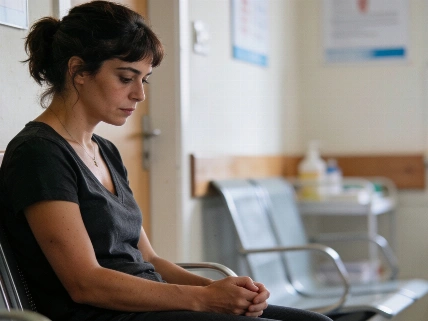
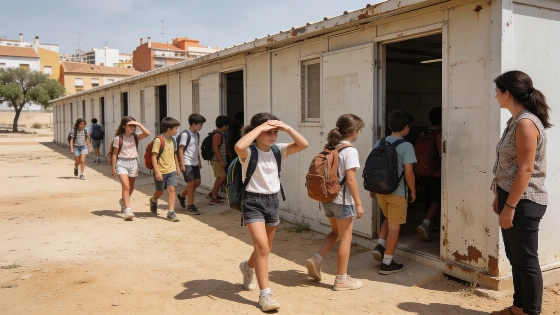
In Valencia’s so-called “zona cero,” the new school year has begun with nearly 3,000 children still attending classes in prefabricated barracones. Two years after floods destroyed schools in Massanassa, Alfafar, Paiporta, and Catarroja, permanent buildings have yet to be built. For now, these makeshift classrooms, which local emergency committees describe as unsafe and unsuitable, are the only option for many families.
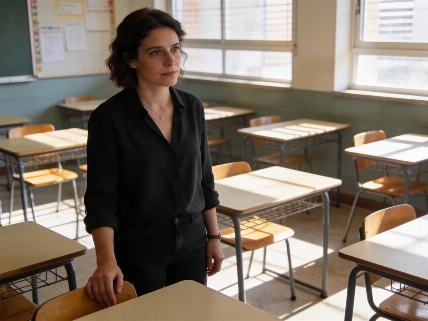
The situation has reignited conflict between the Plataforma per l’Ensenyament Públic, which includes Fampa-València, Escola Valenciana, and the unions STEPV, CC OO, and UGT, and regional education authorities. The coalition says talks last year with the Consejería de Educación, led by Carmen Ortí, yielded little real progress. Union leaders say the reported increase in teaching staff is misleading. Class sizes remain too large, and teacher pay has barely changed. Levante-EMV and El Independiente report that students in the hardest-hit towns are waiting for permanent schools to be rebuilt for the second year in a row.
Approximately 1,500 students at IES Berenguer Dalmau in Catarroja, 300 at CEIP Orba in Alfafar, over 500 at CEI Ausiàs March and CEIP Lluís Vives in Massanassa, and around 400 at CEIP l’Horta in Paiporta continue to study in temporary modules.
Marc Candela of STEPV, the largest public education union, says the current measures fall short and the campaign for better conditions will continue. Óscar Ortiz of CC OO calls the government’s approach patchwork, while Kilian Cuerda of UGT questions why the regional minister blames Madrid for poor PISA results when her own department has delivered no solutions. The unions have called for protests in all three provincial capitals, demanding real investment in public education. Telecinco and Las Provincias report that STEPV, CCOO, UGT, and Plataforma per l’Ensenyament Públic have announced mass protests for September 12 in Valencia, Castellón, and Alicante, citing a lack of meaningful improvements in the public school system.
Parents’ associations are also concerned about new regulations. Elisabet Garcia, president of Fampa València, warns that articles 155 and 156 in the Valencian education code could allow ideological control and intimidate teachers. She says vague language about “ideological neutrality” and “indoctrination” creates legal uncertainty and could chill free expression in schools. La Vanguardia reports that these articles have alarmed parents and associations, who see them as a threat to teaching freedom.
Generalitat president Juanfran Pérez Llorca has urged unions to show “willingness” to reach agreements, defending his administration’s four-year plan as a first step. But for families in the flood-affected towns, those promises feel empty as another school year begins in temporary structures with poor climate control and limited space.
The Generalitat says it has completed emergency repair works totaling 21.6 million euros in more than 60 schools after the DANA floods, including centers in Paiporta, Catarroja, Alfafar, and Massanassa. But, temporary classrooms remain in use, and permanent reconstruction has not started in the hardest-hit areas, El Independiente reported.
The Local Emergency and Reconstruction Committees (CLER) have also warned that little progress has been made on disaster preparedness. They say that, despite scientists’ warnings about rising climate risks, the Generalitat has not set up river flood prediction systems. Many towns have also failed to publish emergency plans or provide training. With more extreme weather expected, the region remains exposed.
These problems are not new. As reported earlier, the start of the school year in Valencia has repeatedly brought disputes over staffing, class sizes, and working conditions. Incremental reforms and political finger-pointing have left thousands of students and teachers in limbo, while the basic issues remain unresolved.
Valencia’s education crisis now tests political will and administrative competence. The continued use of barracones, a lack of climate adaptation, and the risk of ideological controls in schools point to a system struggling to meet its basic responsibilities.