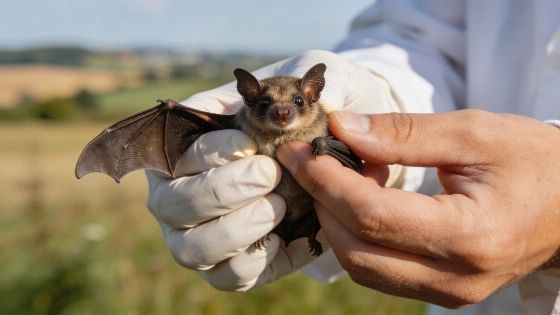
A European bat barely 7 centimeters long has landed at the center of global virus surveillance efforts. Scientists have mapped out which mammal families deserve the closest scrutiny, shifting the focus from broad speculation to precise, data-driven priorities.
A bat small enough to fit in your palm is now central to global efforts to prevent future pandemics. The greater horseshoe bat, Rhinolophus ferrumequinum, measures just 5.7 to 7.1 centimeters and weighs up to 34 grams. Researchers have identified it as a top priority for virus monitoring—not because it is the next threat, but because its family is linked to viruses that have caused deadly outbreaks in humans.
This new focus comes from a large-scale analysis published in Communications Biology on October 30, 2025. The study examined data from 889 mammal species, including 202 types of bats, and mapped 2,637 known virus-host relationships. The takeaway: no single animal is the main culprit. Instead, certain evolutionary branches—like the horseshoe bats (Rhinolophidae)—show a higher statistical risk for carrying dangerous viruses.
"Researchers caution that the apparent concentration of risk in certain species may partly reflect how much those animals have been studied, not just their biology."
— Communications Biology
The idea that all bats pose equal risk doesn’t hold up. The data show that only some lineages, not whole animal groups, are linked to a larger share of viruses associated with human deaths. Horseshoe bats, for example, are notable for their connection to high-mortality viruses, while other mammals like catarrhine primates are more involved in viruses that spread between people. The authors note that these patterns are influenced by how much each species has been studied, but the uneven distribution of risk is clear.
So why focus on horseshoe bats? Their evolutionary history is closely tied to viruses that have already affected humans, including SARS-related coronaviruses and certain lyssaviruses. Within the flavivirus group, both Rhinolophidae and Hipposideridae families show higher average lethality rates. Still, the study does not predict which species will cause the next pandemic. Instead, it offers a practical guide for where to focus limited surveillance resources.
Geography is as important as genetics. By overlaying the ranges of high-risk mammal lineages with maps of human activity, the study highlights global hotspots: Central America, the coasts of South America, equatorial Africa, and Southeast Asia. For flaviviruses, Southeast Asia and sub-Saharan Africa are the main areas of concern. These maps are meant to guide where to collect samples and monitor for new pathogens, similar to how targeted mosquito control helps contain West Nile virus outbreaks.
"Recent years have seen a shift toward targeted viral surveillance based on evolutionary lineages, rather than blanket monitoring of entire animal groups. This approach is supported by evidence that bats can harbor dangerous viruses without showing clinical illness, underscoring the need for focused monitoring."
— Recent scientific reviews
Trying to monitor all 1,500 bat species is neither practical nor necessary. Many bats live in remote areas that are hard to reach, making full-scale surveillance impossible. The study’s approach—prioritizing certain lineages in regions with high human activity—offers a more realistic and effective strategy. Concentrating efforts where risk and human contact overlap increases the chances of catching new viruses early.
There are limits to what this research can show. Finding a virus in an animal does not prove it can infect people. In 38% of cases, the only evidence was serological—signs of exposure, not active transmission. Even PCR results do not guarantee that a host can pass a virus to another organism. The real value of the study is in setting priorities for further investigation, not in naming the next pandemic source.
Large, data-driven studies like this are changing how scientists approach animal surveillance. The same method was used to analyze bumblebee colony dynamics, where millions of interactions revealed hidden social changes. In both cases, the lesson is the same: targeted, evidence-based monitoring is more effective than broad, unfocused efforts. By focusing on concrete data and evolutionary context, public health can move away from fear-driven responses and toward prevention that actually works.
The main difference in this new approach is discipline. Instead of chasing headlines or blaming entire animal groups, the research calls for surveillance guided by data and evolutionary logic. This is not just a scientific improvement—it corrects years of scattered, reactive monitoring. If public health authorities follow this roadmap, the world has a better chance of catching the next viral threat before it spreads. Ignoring these findings means going back to guesswork, and that is a risk no one can afford.