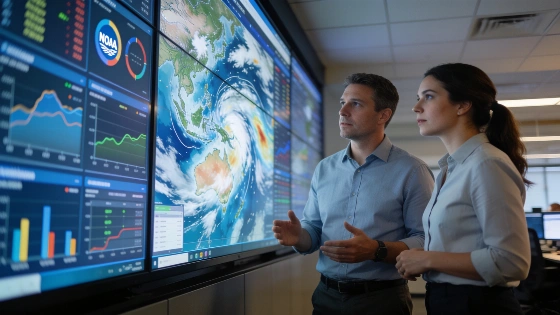
NOAA has tapped Tomorrow.io to support the Earth Prediction Innovation Center, a move set to overhaul the Unified Forecast System and sharpen the nation’s weather prediction capabilities. The collaboration brings private sector expertise into the heart of US forecasting infrastructure.
NOAA has brought Tomorrow.io on board to help modernize the country’s weather prediction systems. The company will provide contracting support for the Earth Prediction Innovation Center (EPIC), a program focused on updating NOAA’s operational modeling. The goal is to speed up work on the Unified Forecast System (UFS), a new Earth modeling platform built around open science and collaboration between public and private sectors.
NOAA’s strategy is to break down barriers between agencies and organizations, unify model development, and move research into daily operations more quickly. The new contract with Tomorrow.io is part of this push. NOAA Administrator Neil Jacobs, Ph.D., described EPIC as an opportunity to strengthen U.S. leadership in weather prediction by bringing together expertise from government, industry, and academia.
Tomorrow.io was also named as a commercial provider in NOAA’s long-term satellite data contracts for multiple observation categories, including radio occultation and multispectral imaging, in September 2026.
EPIC, launched in 2019, was set up to open NOAA’s modeling infrastructure to a wider research community. By involving universities, public agencies, and private companies, the program aims to move scientific advances into the operational models used by the National Weather Service more quickly. EPIC handles planning and scientific work, while Tomorrow.io will focus on software, engineering, and user support—key areas for a system that serves a broad range of users.
The Unified Forecast System is NOAA’s answer to the patchwork of older models. Instead of running separate systems for atmosphere, ocean, and land, the UFS brings them together in one flexible framework. The aim is to deliver more accurate and timely forecasts, whether for local storms or global climate patterns. Tomorrow.io’s experience will be important as NOAA adds the Model for Prediction Across Scales (MPAS), the computational engine for the new system’s atmospheric forecasts.
Ken Graham, director of NOAA’s National Weather Service, called the partnership a step toward building a fully integrated Earth System Model. For the Weather Service, this is more than a technical update—it’s about making the country better prepared for severe weather and water events.
According to official NOAA materials, EPIC is part of a broader strategy to accelerate the modernization of forecasting infrastructure by fostering open science and community-driven development. This approach is intended to speed up the integration of new models and data, giving private providers more entry points into the national meteorological system.
Thomas Cavett, Tomorrow.io’s vice president for U.S. Federal Business, said the company is committed to strengthening the nation’s forecasting models and infrastructure. He pointed to Tomorrow.io’s background in AI modeling and satellite observations as a good fit for NOAA’s mission to protect lives and property in the US and for partner countries.
EPIC’s role is backed by legislation. The Weather Research and Forecasting Innovation Act of 2017 and the National Integrated Drought Information System Reauthorization Act of 2018 both direct NOAA to focus on improving weather data, modeling, and forecasting. Congress has made it clear that speeding up community-driven advances is a matter of public safety and economic security.
By bringing Tomorrow.io into the project, NOAA is moving toward a more open and collaborative approach. Sharing responsibility for high-performance computing and community engagement marks a shift from closed, incremental development. The focus is now on building a system that can keep up with scientific progress and the demands of a changing climate. This partnership could set a new example for how public agencies and private companies work together on critical infrastructure, and it raises expectations for what US weather forecasting can deliver in the coming years.