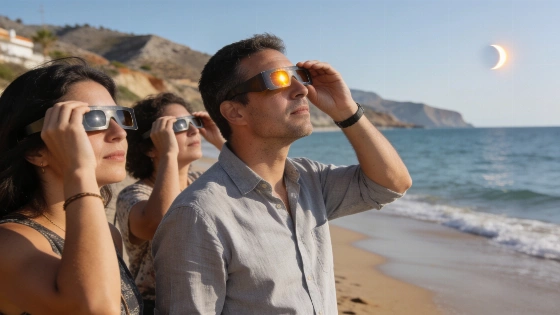
On August 2, 2027, a total solar eclipse will cross southern Spain. Only a narrow coastal strip and the autonomous cities will witness full coverage. The event will last longer than the 2026 eclipse.
Southern Spain is set to become the focal point for skywatchers on August 2, 2027, when a total solar eclipse will sweep across a narrow band of the region. Unlike the recent eclipse, which offered a broad path of totality across much of the peninsula, next year's event will be visible in its entirety only from select coastal areas and the autonomous cities of Ceuta and Melilla. The rest of Spain, including the Canary Islands, will see only a partial eclipse.
The central line of the eclipse will cross the Strait of Gibraltar and the Alboran Sea, before continuing into North Africa. In Spain, the total phase will be restricted to a slim coastal corridor. In Almería, for example, residents of the city will need to head out to the bay by boat to experience totality, while those in Cabo de Gata or Roquetas de Mar will be able to watch the full spectacle from land. Granada province will see totality only along the coast, in towns such as Motril, Salobreña, and Almuñécar. Málaga stands out, as both the city and its main tourist areas fall within the path of totality.
The most dramatic viewing conditions are expected in Cádiz, Ceuta, and Melilla. Nearly the entire province of Cádiz will experience a prolonged period of darkness, with the eclipse lasting between four and almost five minutes in Ceuta, Melilla, Tarifa, and the Bay of Algeciras. This duration is nearly three times longer than the 2026 eclipse. After leaving Spain, the eclipse will continue across the Algerian desert, the Libyan coast, and the Nile valley, where the total phase will last even longer—over six minutes in southern Egypt, making it one of the longest in recent decades.
One key difference from the previous event is the timing. While the last eclipse occurred at sunset, the 2027 eclipse will take place in the morning. The full event will last 313 minutes, beginning at 9:30 a.m. over the Atlantic and ending at 2:43 p.m. in the Indian Ocean. In southern Spain, the most significant phase will start around 10:00 a.m., with totality beginning at 10:45 a.m. Ceuta will see the longest duration in Spain, with four minutes and forty-eight seconds of total darkness.
This eclipse is the second in a trio of major Iberian solar eclipses, following the 2026 event and preceding an annular eclipse in January 2028. The 2028 eclipse will enter Spain via the Canary Islands, cross Huelva and Cádiz, and exit through Girona. Unlike the previous two, it will be annular, meaning the Moon will not completely cover the Sun, resulting in a 'ring of fire' effect. For those interested in the broader context of astronomical events in Spain, the alignment of the Perseids meteor shower and the 2026 total solar eclipse was previously highlighted in a report on the rare double event.
Solar eclipses are rare and highly anticipated events in Spain. The 2027 eclipse stands out for its limited geographic reach and extended duration in certain areas. Observers are advised to plan ahead, as the best viewing spots will be concentrated along the southern coast and in the autonomous cities. The next opportunity for a total solar eclipse in Spain after this trio will not occur for several decades, making the 2027 event a unique occasion for residents and visitors alike. As with all solar eclipses, proper eye protection is essential to safely enjoy the phenomenon.