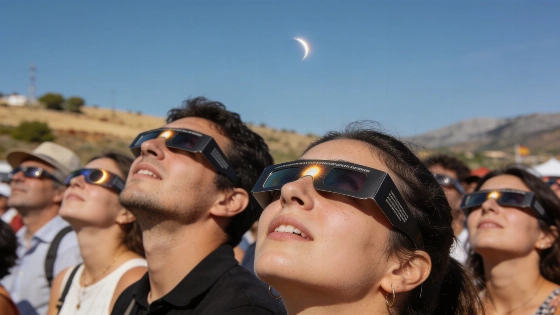
On August 12, Spain will witness a rare total solar eclipse. The path of totality will cross 13 regions, while the rest of the country will see only a partial eclipse. Authorities have set up official viewing sites to manage crowds.
Spain is preparing for a rare astronomical event on August 12, when a total solar eclipse will cast a shadow across nearly 40% of the country. The phenomenon will be most dramatic in a wide band stretching through 13 of Spain’s 17 autonomous communities, where the Moon will completely cover the Sun for almost two minutes. In these areas, residents and visitors will experience a brief period of total darkness in the middle of the day—a spectacle not seen in Spain for years.
Outside the path of totality, the rest of Spain will observe a partial eclipse, with the degree of solar coverage varying by location. According to EL PAÍS, an interactive map has been published to help the public compare the timing, duration, and intensity of the eclipse in different provinces. The map also highlights the central line of totality, considered the optimal spot for viewing, and includes a shadow overlay to indicate where the Sun may be obscured by local terrain at the peak moment.
The eclipse’s shadow will touch at least 31 of Spain’s 50 provinces, making the event accessible to a large majority of the population. However, only those within the totality band will witness the full blackout, a much shorter and more intense experience than the partial eclipse visible elsewhere. Local authorities are urging people who live or vacation within the totality zone to choose observation points close to home, aiming to prevent unnecessary travel and potential traffic congestion on August 12.
To manage the expected influx of eclipse watchers, regional and municipal governments have designated official viewing areas. These sites have been selected for their clear skies, low risk of cloud cover in August, and safe conditions for observing the eclipse. So far, EL PAÍS has identified 190 official locations across the country, which can be consulted on their interactive map. In addition, many local councils are preparing to handle large gatherings, ensuring that the event can be enjoyed safely and without incident.
Interest in the August eclipse comes amid a summer of notable weather events in Spain. Earlier this month, meteorological forecasts pointed to a brief drop in temperatures before another heatwave, as detailed in recent coverage of Spain’s August weather outlook. The eclipse is expected to draw significant attention from both residents and tourists, especially in regions where the totality will be visible.
Solar eclipses occur when the Moon passes directly between the Earth and the Sun, temporarily blocking sunlight. Total eclipses are rare for any given location, making this event particularly significant for Spain. Observers are reminded to use proper eye protection when viewing the eclipse, as looking directly at the Sun can cause permanent eye damage. The next total solar eclipse visible from Spain is not expected for several decades, adding to the importance of this year’s event for astronomy enthusiasts and the general public alike.