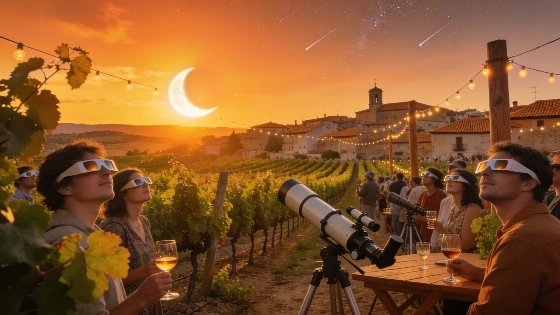
On August 12, Spain will witness a rare total solar eclipse. The path of totality will cross major cities and rural areas. Special events are planned in hotels, wineries and scenic towns.
Spain is set to become the focal point for astronomy enthusiasts and travelers on August 12, when a total solar eclipse will sweep across the country for the first time since 1905. The event, visible at sunset, will plunge a wide swath of the peninsula into darkness for up to nearly two minutes, depending on location. The path of totality will stretch from La Coruña in the northwest to Palma in the Balearic Islands, passing through cities such as Oviedo, León, Bilbao, Zaragoza and Valencia. The phenomenon is expected to draw both local residents and international visitors, with demand for accommodation in the eclipse zone already pushing rural house prices to luxury hotel levels.
In Rueda, the Finca Montepedroso winery is preparing a unique experience that combines wine tasting, live music and a cocktail dinner curated by the Michelin-starred Trigo restaurant. Guests will have access to solar telescopes and expert guidance from AstroAfición, allowing them to observe the chromosphere—an otherwise invisible layer of the sun. The totality in Rueda will last approximately 1 minute and 40 seconds, offering a rare view of the solar corona.
La Coruña will be among the first Spanish cities to witness the eclipse. Civitatis is organizing guided tours of the city’s landmarks, including the UNESCO-listed Tower of Hercules, before moving to Monte de San Pedro for panoramic coastal views during the eclipse. In Oviedo, the city has designated four official observation points, with Monte Naranco providing sweeping western vistas and proximity to the historic pre-Romanesque churches of Santa María del Naranco and San Miguel de Lillo. These sites are expected to attract families and large groups, as they are equipped to handle significant crowds.
León, Burgos and Palencia are highlighted for their clear skies, making them prime observation spots. The European Space Agency will be stationed in León to study the eclipse. In Palencia, the historic Fábrica del Canal hotel will host a chill-out area with music, drinks and gourmet dining along the Canal de Castilla. Castrojeriz in Burgos, a key stop on the Camino de Santiago, sits directly in the eclipse’s path and is expected to surprise many pilgrims. The Portia winery in Burgos, designed by Norman Foster, will offer eclipse viewing from its highest point, followed by a cocktail and wine tasting as the Perseid meteor shower begins to appear.
Segovia province, close to Madrid, has set up eight official viewing points, including the picturesque villages of Turégano and Riaza. Álava will also be almost entirely within the path of totality, with hotels and restaurants booked out months in advance. The abundance of wineries in La Rioja Alavesa and La Rioja itself increases the options for visitors. The Alto de San Vicente, between Briones and San Vicente de la Sonsierra, will host an event called Eclipse en el Alto entre Viñedos, offering panoramic views of the Ebro valley and a blend of eclipse and meteor shower experiences among the vineyards.
In Teruel, Arcos de las Salinas will host the Galáctica Eclipse Experience 2026, bringing together scientists, educators and visitors for workshops, guided tours and sky observation. Valencia offers the chance to sail to the Columbretes Islands or take a traditional boat ride on the Albufera during the eclipse. The Balearic Islands, especially Ibiza and Menorca, are preparing sophisticated themed events. Nômade Temple Ibiza will combine sound healing and ceremonial dinners by the sea, while Son Ermitá in Menorca will offer a gastronomic evening with live music and views of both mountains and sea.
The eclipse coincides with the peak of the Perseid meteor shower, adding to the astronomical spectacle. According to El Mundo Viajes, anticipation for the event has been building for years, with many activities and accommodations booked well in advance. The rare overlap of these two celestial events is expected to make August 12 a landmark date for tourism and science in Spain. For those interested in how major events can transform local tourism and infrastructure, the recent return of live San Fermín bull runs offers a parallel in terms of regional impact and visitor influx.
Spain’s position as the epicenter of this summer’s “eclipsemania” is underscored by the diversity of experiences on offer, from coastal observation points to vineyard dinners and scientific gatherings. The event is not only a rare astronomical occurrence but also a catalyst for local economies, hospitality and cultural programming across the country. With the next total solar eclipse over Spain not expected for decades, August 12 is shaping up to be an unforgettable date for residents and visitors alike.