On 12 August 2026, Castilla-La Mancha will experience a total solar eclipse. The shadow will cross Guadalajara and northern Cuenca, creating a rare twilight. Authorities urge early arrival and strict eye protection for safe viewing.
On 12 August 2026, parts of Guadalajara and Cuenca will briefly turn to dusk as the Moon completely covers the Sun. This total solar eclipse will cut across the northeast of Castilla-La Mancha, drawing eclipse watchers and scientists from across Europe. The event peaks just before sunset, so anyone hoping to see it will need to find a high, clear spot facing west. Reports from Reuters and Spanish media expect millions across Spain to watch, as this will be the first total solar eclipse visible from the Iberian Peninsula in more than a century.
Guadalajara sits directly in the path of totality. The shadow arrives at 20:31 and lasts just over a minute, making it the longest period of complete darkness on mainland Spain. The province's rugged landscape and dark skies attract both amateur and professional astronomers. Popular viewing spots include the limestone canyons of Parque Natural del Alto Tajo, the plateaus of Señorío de Molina, and the Observatorio de Yebes, which will offer guided sessions with solar telescopes and certified eclipse glasses. According to Spanish scientific reviews, the northeast of Castilla-La Mancha—especially Guadalajara and Cuenca—should have the best conditions for seeing the total phase, thanks to its weather history and easy access.
The 2026 eclipse will be the first total solar eclipse visible from the Iberian Peninsula in more than a century, with the next similar event in Spain not expected until August 2027, but in a different region.
Cuenca's Serranía, known for its clear night skies, will also see totality at 20:31. For about ninety seconds, the solar corona will be visible to the naked eye, set against pine forests and rocky cliffs. The area's low population and clear air make the natural viewpoints of the Cuenca massif a top choice for those wanting a dramatic setting. Experts in national media note that, because the eclipse happens late in the day with the Sun low on the horizon, only those at open, west-facing spots will get the full effect.
Elsewhere in Castilla-La Mancha, the eclipse will still be striking. Toledo and Albacete will see more than 99 percent of the Sun covered, turning the landscape into deep twilight. In Ciudad Real, coverage will reach 98.2 percent, especially noticeable in the Campo de Calatrava and higher areas. The Mirador de Estrellas de Almansa in Albacete, another dark-sky site, will provide solar-filtered equipment for safe viewing. Spanish meteorological and astronomical groups have highlighted the region's interior as a promising area for eclipse watching, thanks to its weather and open views.
The timing matters. The partial phase starts at 19:35, with totality between 20:29 and 20:33, depending on where you are. The eclipse ends at 21:22, almost at sunset. Because of this overlap, only those on high, west-facing ground will see the whole event. Authorities warn that roads to the best spots may be crowded, so visitors should arrive at least three hours early, bring water and sun protection, and check the weather forecast.
In the lead-up to the 2026 eclipse, expert and tourism publications emphasized the advantages of Castilla-La Mancha's interior regions for observation, citing lower historical cloudiness and easier access compared to coastal areas. However, official statements from regional authorities or the Yebes Observatory have not been issued, with most guidance echoing national safety advice and scientific context.
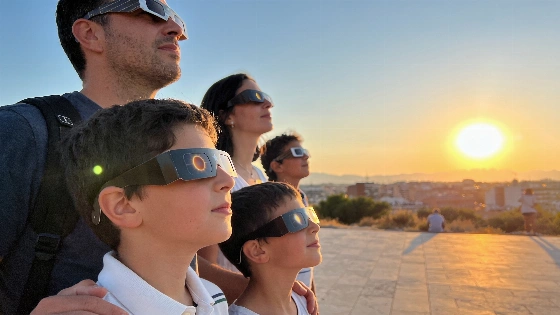
Safety is essential. Looking at the eclipse without proper protection can cause permanent eye damage. Only ISO 12312-2 certified glasses are allowed during the partial phases. Binoculars, cameras, or telescopes without solar filters are banned, as are makeshift solutions like smoked glass or X-rays. Organizers across the region plan to enforce these rules strictly. Spanish press coverage notes that the event has become a major scientific and tourism draw, leading to widespread sharing of safety and logistical advice.
Interest in astronomy has grown in Spain in recent years, as seen during the record heatwave in Barcelona reported earlier. The 2026 eclipse is expected to bring thousands to Castilla-La Mancha, with local authorities preparing for crowds not seen since the last major celestial event. The region's open landscapes and dark skies offer a rare mix of accessibility and good viewing, making it a key spot for European astronomy.
With the date approaching, the message is clear: anyone hoping to see the total eclipse needs to plan ahead, follow safety rules, and be ready for busy rural roads. The event will test the region's ability to handle large numbers of visitors and highlights Spain's growing appeal for science tourism. As the shadow crosses Castilla-La Mancha, the eclipse will show that even in a digital age, nature's biggest events still draw crowds and require careful preparation. Strict safety and crowd control are necessary to make sure this astronomical event is remembered for the right reasons.