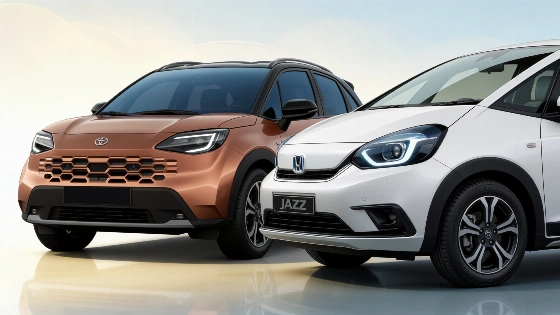
Toyota Yaris Cross and Honda Jazz both offer efficient hybrid driving, but only one meets the space and versatility needs of Spanish buyers. The real difference shows up in the boot and on the road.
Choosing a hybrid SUV that fits real life often comes down to the details. The Toyota Yaris Cross, with its 397-litre boot, gives you nearly 100 litres more space than the Honda Jazz. For anyone packing for a weekend away, that difference is hard to ignore.
But it’s not just about luggage. The Yaris Cross is longer, taller, and wider than the Jazz—measuring 4,180 mm in length—so it feels more substantial and practical, especially for families who need every bit of room. For many Spanish buyers, that extra space is the deciding factor.
The latest Toyota Yaris Cross update in 2026 introduced the Hybrid 130 version with 130 DIN hp and 185 Nm, setting a new benchmark for power in its class.
The Honda Jazz, though, has its own strengths. Its 4,090 mm frame hides a cabin designed for flexibility, with Magic Seats and a flat floor that make it easy to load awkward items. The Jazz’s 300-litre boot is smaller, but the clever interior layout makes it a good fit for city drivers who care more about versatility than raw volume.
Both cars use a single non-plug-in hybrid powertrain and carry the ECO label from the DGT. The Yaris Cross combines a 1.5-litre three-cylinder petrol engine with an electric motor for a total of 130 CV and 185 Nm of torque. It’s available with front-wheel or all-wheel drive—something the Jazz doesn’t offer. Depending on the version, Toyota claims fuel use between 4.5 and 5.1 l/100 km.
The Honda Jazz e:HEV uses a 1.5-litre four-cylinder petrol engine and two electric motors, producing 122 CV. Its automatic CVT transmission keeps things smooth, and it’s efficient in real-world driving, though it can’t match the Toyota for outright power.
According to independent reviews and technical data from Autosalon and Wayke, the Yaris Cross is available in two hybrid configurations: Hybrid 115 (116 hp) and Hybrid 130 (130 hp), both with e-CVT. The Hybrid 130 version can be ordered with either front-wheel drive or AWD-i, making it more versatile than the Honda Jazz, which is only offered with front-wheel drive.
Price is where the Jazz stands out. It starts at 24,600 euros, undercutting the Yaris Cross by 2,900 euros. For buyers who don’t need the SUV look, that’s a real saving. The Jazz also comes with more standard features: heated seats, adaptive cruise control, Honda SENSING safety tech, and the Magic Seats system are all included. The Yaris Cross starts at 27,500 euros and includes basics like a 9-inch touchscreen, digital instrument cluster, and rear camera, but some features found on the Jazz require moving up the range.
The Yaris Cross’s strong sales in Spain are no accident. Its bigger size, higher power, and choice of drivetrains have made it a regular on the country’s bestseller lists. The Jazz, while practical and well-equipped, remains a niche pick—overshadowed by the Toyota’s broader appeal.
As previous analysis of the family SUV segment shows, buyers in Spain are less willing to compromise on space and versatility, even in smaller cars.
In the end, the Toyota Yaris Cross sets the standard for hybrid SUVs in Spain: space, power, and the option of all-wheel drive, all in a package that suits Spanish roads and family needs. The Honda Jazz is a smart choice for those who want a lower price and clever interior design, but it can’t match the Toyota’s all-round strengths. For most buyers, the Yaris Cross is the more practical pick.