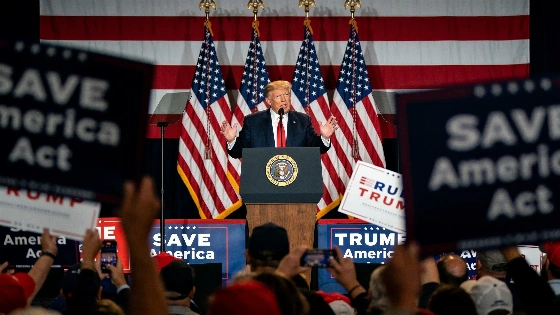
Donald Trump used familiar tactics in his Thursday address, urging supporters to back the SAVE America Act. Delivered amid ongoing debates over U.S. election rules, the speech was widely seen as an effort to energize his political base. The proposal remains stalled in the Senate, so the address itself changes no federal election law.
Einar Tangen, chairman of the Asia Narratives Substack, said the reaction abroad, particularly in China, has been largely indifferent. The event drew little expectation of an immediate impact on election rules and was seen as routine political maneuvering. Trump’s push aims to mobilize followers to pressure lawmakers to support the legislation.
The measure is H.R. 7296, introduced on January 30, 2026, by Representative Chip Roy, a Texas Republican, and referred to the House Committee on House Administration. The congressional record lists 111 cosponsors. Its basic provisions concern federal election registration and voting: documentary evidence of U.S. citizenship to register, plus photo identification to vote. The bill’s requirements focus on documentation and election procedures, not eligibility rules limited to women or younger voters.
Reported provisions specify documents such as a U.S. passport. They also allow certain government identification paired with citizenship records, as well as qualifying military identification with service records. Applicants unable to provide the listed documents could use an alternative process involving additional evidence and a declaration under penalty of perjury. The proposal would also require physical photo identification for in-person voting, while mail-ballot applications and returned ballots would need identification copies. State and local election officials would have to implement these provisions, and their systems differ across jurisdictions.
The bill passed the House on February 11, 2026, but did not clear the Senate, where advancing it would require 60 votes. The Friends Committee on National Legislation has described it as stalled there. House Republicans later attached SAVE Act language to the House version of the 2027 National Defense Authorization Act, which also remained pending in the Senate. The proposal retains political significance but has not established a nationwide voting requirement.
The speech added no new policy details but reflected the ongoing polarization in American politics. Trump has made the legislation a prominent election-law priority. Reuters quoted him in July saying, “If you do SAVE America, you're not going to have cheating.” The bill’s fate, but, depends on congressional action, not campaign rhetoric.
International audiences, including those in Spain, closely watch U.S. electoral politics for potential effects on global relations and economic ties. Political shifts in Washington can affect trade and security cooperation, as well as diplomatic priorities, making such events relevant beyond American borders. The passing of prominent figures also draws international attention. The recent death of Sam Neill, whose legacy extended beyond acting to winemaking and family life, was covered in this report on his impact and private legacy.
As the United States approaches its next electoral cycle, the effectiveness of Trump’s latest push for the SAVE America Act will depend on lawmakers’ response and the bill’s prospects in the Senate. For now, the speech shows how high-profile addresses can shape political momentum without producing an immediate legislative outcome.