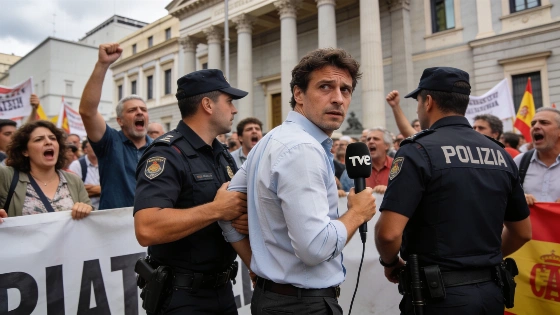
A TVE reporter was harassed by protesters in Madrid during rallies over Ceuta’s migrant crisis. Police intervened as political divisions deepened and rival demonstrations spread across Spain.
A tense scene unfolded outside Spain’s Congress of Deputies when a Televisión Española journalist was surrounded and shouted at by protesters demanding action over Ceuta’s migrant crisis. The crowd chanted "prensa española, manipuladora" and police had to escort the reporter away. According to Spanish media, the journalist was insulted, shoved, spat on, and nearly assaulted before officers intervened.
The incident happened as rallies took place across Spain, called by the Federación Española de Municipios y Provincias (FEMP) to coincide with the Día de Ceuta. The aim was to show support for the city, but the protests instead highlighted deep political divisions. Reuters reported similar demonstrations in Barcelona, Bilbao, and other cities, with Madrid drawing the largest crowd and chants against migrants and the government.
Official estimates of the Madrid protest ranged widely, with the Delegación del Gobierno citing 50,000 attendees, while the city council put the figure at 150,000.
The Madrid protest drew extra attention because Partido Popular leader Alberto Núñez Feijóo and Vox president Santiago Abascal attended. Their presence gave the event a clear political edge, which the PSOE strongly criticized. The Socialists called the FEMP’s move unilateral and accused organizers of using Ceuta’s crisis for political purposes. Spanish outlets like El Diario and Antena 3 noted that opposition leaders’ attendance fueled the sense of political maneuvering.
In response, several PSOE-led municipalities—including Valencia, Huelva, Córdoba, and Cádiz—held their own rallies. These gatherings focused on institutional unity and rejected what they called "partidismo" in the face of Ceuta’s humanitarian emergency. According to El País, more than 260 municipalities joined the FEMP’s actions, but the Socialists criticized the format as one-sided and political.
Meanwhile, frustration in Ceuta itself has spilled into the streets. Thousands marched with banners demanding real solutions from national and regional authorities. Many said symbolic gestures were not enough.
The Ceuta crisis has prompted Spain to request assistance from Frontex and Europol, while Italy has extended border controls with Spain in response to the surge in migration. The Spanish government recently announced a €165 million emergency aid package for Ceuta, and Minister Ángel Víctor Torres stated that all migrants who entered illegally during the crisis would be returned in accordance with the law.
The unrest in Madrid is the latest sign of a crisis that has already seen Ceuta’s residents mobilize in large numbers. As reported earlier, the city faces intense pressure, with local leaders warning of neglect and a lack of effective response. Reuters and other international sources confirm that Ceuta has seen long, large-scale demonstrations, showing the depth of local frustration.
Inside Madrid, the incident with the TVE journalist has become a symbol of the breakdown in public debate. Needing police protection for reporters at a protest points to a growing lack of trust—not only between citizens and the media, but also among Spain’s political institutions. According to El Mundo and El Diario, attacks on journalists are rare but have become more common as tensions rise.
This episode shows a country struggling with both a humanitarian emergency and political infighting. The decision by opposition leaders to headline the Madrid rally, while the government and its allies organized separate events, highlights how little agreement there is. When journalists are targeted and solidarity breaks down along party lines, Spain’s response to the crisis loses credibility. Until political leaders focus on real solutions, Ceuta’s problems—and the divisions they reveal—are likely to continue.